
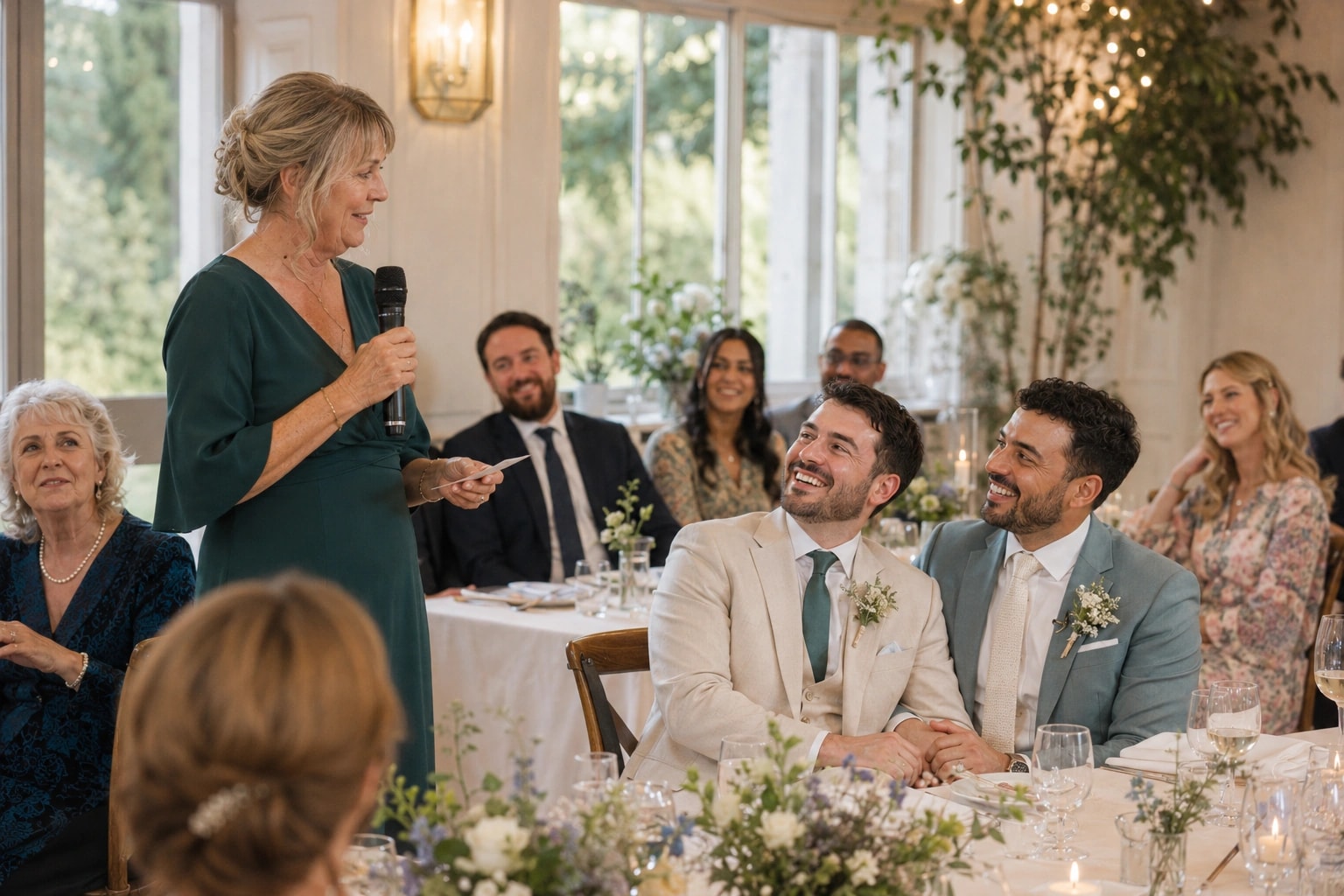
A broader role
This speech should fit the family you actually have
Wedding-speech advice often assumes one neat family structure, one speaking order and one set of traditions. Real weddings are rarely so tidy. The speaker may be a mother, father, step-parent, adoptive parent, guardian or another family figure who has played that role in practice, regardless of title.
That is why this speech should begin with the actual relationship. You are not standing up to perform a stereotype. You are speaking because the couple value your voice, your perspective and the part you have played in their lives.
Traditional conventions may still be useful. They can prompt a welcome, a toast or an acknowledgement. Keep them where they genuinely suit the wedding, and leave them out where they do not.
Choose one strong memory
The best family stories reveal the adult in front of you now
Childhood and family memories work best when they do more than prove you have known the person a long time. The story should reveal a quality that still feels true now: kindness, determination, humour, stubbornness, generosity or the habit everybody close to them recognises immediately.
One vivid memory is usually enough. Give the audience the scene, the small detail that makes it memorable and the reason it still matters. Resist the temptation to summarise an entire childhood.
Fictional illustrative example
A family memory connected to the present
“When Marcus was ten, he decided the garden fence was clearly in the wrong place and that the simplest solution was to move it himself. He had no plan, no permission and only a fairly small hammer.”
“The fence did not move very far, but Marcus did convince three neighbouring children that this was now a shared infrastructure project.”
“That mixture of confidence, determination and ability to gather people around an idea has stayed with him ever since — fortunately with better tools and much better judgement.”
This is fictional illustrative writing. Your speech should use your own memories, family tone and details.
A useful structure
A parent wedding speech shape that feels natural
The structure below helps the speech move from your family perspective towards the couple and the future they are creating together.
- 01
Open in your own voice
Begin simply and confidently. A brief welcome or reflection is enough; you do not need a formal script unless that suits the wedding.
- 02
Say what the day means to you
Acknowledge the significance of the moment and your place in it, without slipping into stock phrases or outdated assumptions.
- 03
Tell one revealing memory
Choose a story that shows something recognisable about your child or the person you are speaking about.
- 04
Connect the memory to the present
Show how that quality still appears in the adult they are now and why it makes you proud.
- 05
Include the partner warmly
Speak about what you appreciate in them and what becomes clear when the couple are together.
- 06
Celebrate the relationship
Move from family history towards the life the couple are creating together, keeping any advice short and personal.
- 07
Finish with a clear toast
Use both names, make one sincere wish and invite the room to raise a glass.
Including the partner
Welcome the person, not an abstract role
The partner should feel meaningfully included, not added at the last minute because convention demands it. Speak about what you value in them, what you noticed when the relationship became serious or what becomes visible when the two of them are together.
You do not need to say that you knew immediately they were perfect. Honest warmth is stronger than exaggerated certainty. One specific quality or observation will usually mean more than a generic welcome.
Phrases such as “welcome to the family” may be right for some people. For others, it will be more natural to talk about how glad you are that this person is part of your lives, or how happy you are to see the couple build something together.
Humour with care
Choose warmth over embarrassment
Family speakers often have years of stories to choose from. That does not mean every story belongs in a wedding speech. The aim is for the person you are speaking about to feel seen and loved, not managed in public.
Worth including
- A harmless family story that reveals a recognisable quality.
- Gentle humour about your own role as a parent.
- Specific details that make the memory feel real.
- A story that moves naturally from laughter into pride.
- Material that works for relatives, friends and newer guests alike.
Usually best avoided
- Humiliation, private conflict or stories requiring explanation afterwards.
- Ex-partners or relationship history the couple would not want public.
- Comments on appearance, fertility, money or family pressure.
- Treating one partner as an outsider or a problem to be solved.
- Anything likely to upset the couple on the day.
Modern families
Use language that fits the real relationships
In blended, adoptive, separated or otherwise non-traditional families, the worst thing a speech can do is force everybody into language that does not reflect reality. Thank and acknowledge people according to their actual place in the couple’s lives.
If several parental figures are present, agree in advance who is covering which parts of the day. That avoids repetition and reduces the risk of awkward omissions.
If there are sensitive relationships or absences, speak to the couple first. One well-judged acknowledgement may be meaningful; an unexpected emotional turn can be much harder to manage in the room.
The sincere part
Say plainly what makes you proud
Many parent speeches become memorable at the point where the speaker stops narrating family history and speaks directly. You do not need elaborate language. A clear sentence about what you admire, what you have witnessed or what you hope the couple understand will carry more weight than a page of familiar wedding phrases.
Fictional illustrative example
A simple, direct turn
“Marcus, I have been proud of plenty of achievements over the years, but what stays with me most is the way people feel around you. You make room for them. You notice who needs encouragement and who would benefit from a little more confidence than they currently have.”
“Seeing that same generosity returned to you by Aisha has been one of the real joys of watching the two of you together.”
The final toast
End with the couple, not with another story
Once you have reached the toast, stay there. Use both names clearly, look towards them and make one sincere wish for the future. The ending should feel like the destination of the speech, not the moment before one last anecdote.
From family stories to finished speech
How SpeechAnvil helps create your parent wedding speech
The guided interview asks about family memories, the adult the person has become, the qualities that make you proud and what you see in the couple together. It also lets you set the humour level, identify sensitive subjects and choose the target length.
SpeechAnvil then creates a personalised plan and one written sample moment, so you can judge the structure and tone before deciding whether to buy the completed speech.
Start my parent wedding speech