
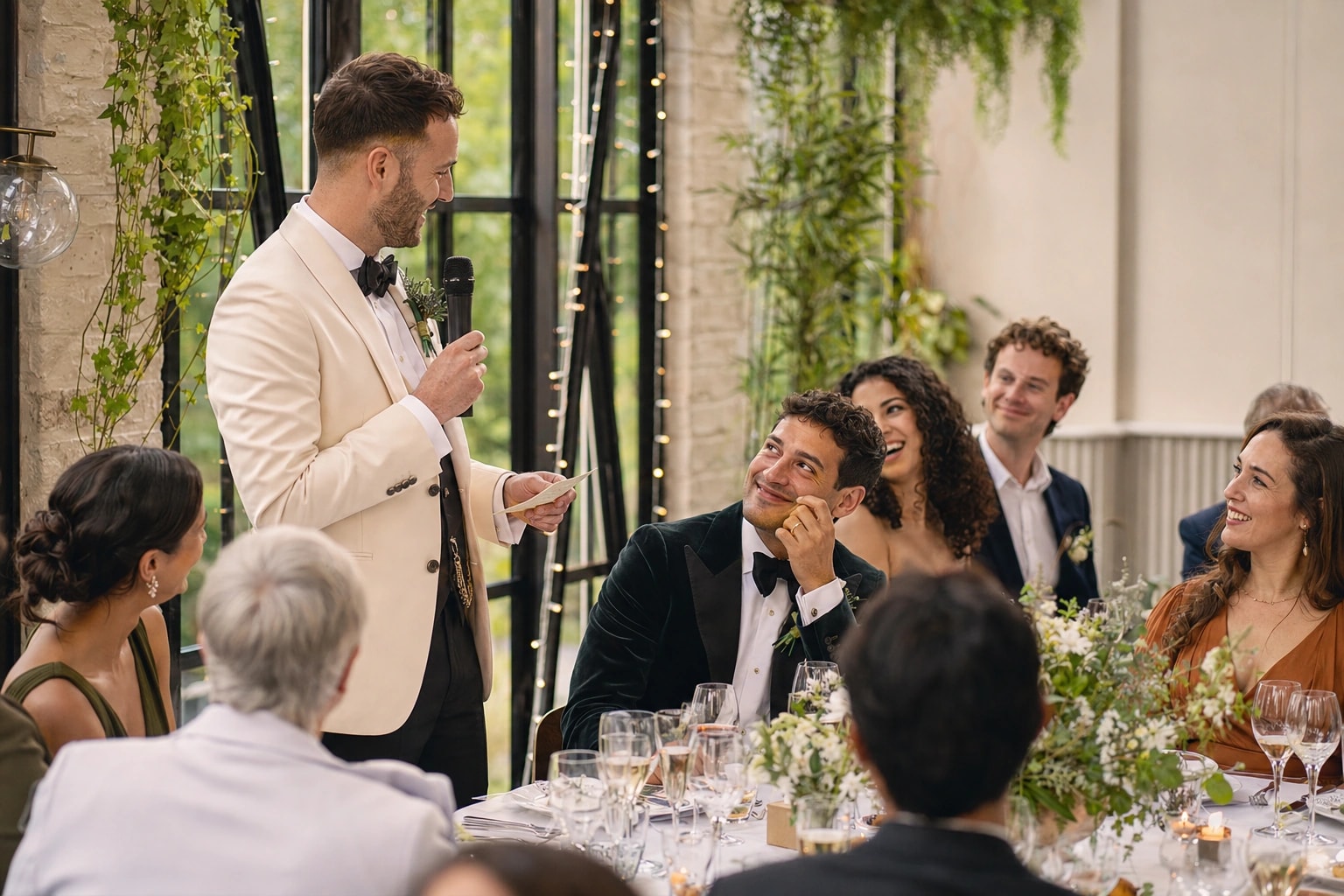
The balance to strike
A groom speech has several jobs, but only one emotional centre
The groom may be expected to welcome guests, thank families, recognise the wedding party and acknowledge everybody who helped make the day possible. Those responsibilities matter, but they can easily take over.
The speech is ultimately being given because you have just married somebody you love. Your spouse should not have to wait through six minutes of acknowledgements before discovering what you want to say to them.
Think of the formal elements as the supporting structure. The heart of the speech is your relationship: how you arrived here, what you admire and why this day means more than a successful event.
The opening
Begin as yourself rather than as the wedding administrator
You do not need a grand opening joke or a formal announcement. A simple welcome, a brief acknowledgement of the moment and one natural observation about the day can settle both you and the room.
It is fine to admit that speaking in front of everyone feels unusual. Keep that admission brief, however. Repeatedly announcing how nervous or unprepared you are encourages the audience to become nervous for you.
Fictional illustrative example
A relaxed groom-speech opening
“Thank you all for being here. Looking around this room, it is slightly overwhelming to see so many different parts of our lives gathered in one place — particularly as several of you have previously insisted you would never attend anything requiring a tie.”
“But seeing everybody here with us means more than I can properly explain, and Sophie and I are incredibly grateful that you chose to share this day.”
This is fictional illustrative writing. Your speech should reflect your own guests, relationship and natural voice.
A dependable shape
A groom speech structure that keeps the relationship visible
This sequence gives the necessary acknowledgements enough space without allowing them to crowd out your spouse or the story of the two of you.
- 01
Welcome the room
Open simply, acknowledge the significance of the day and help guests settle into the speech without beginning with a long administrative list.
- 02
Thank people in meaningful groups
Recognise those who travelled, supported the couple or helped create the wedding. Explain why their contribution mattered rather than reading a directory of names.
- 03
Include both families with care
Acknowledge the relationships that are important to you and your spouse, using language that fits the real family rather than a traditional template.
- 04
Tell one story about the relationship
Choose a moment that shows when the relationship became important, what you learned about your spouse or why life together feels different.
- 05
Speak directly to your spouse
Move from speaking about them to speaking to them. Say what you admire, what they have changed or what being married to them means.
- 06
Look towards the life ahead
Offer a brief thought about the future without turning the speech into a list of promises or a second set of wedding vows.
- 07
Finish with a clear toast
Invite the room to celebrate your spouse, your marriage or everybody who has shared the day, then allow the ending to stand.
Giving thanks
Make gratitude sound personal rather than procedural
A long sequence of names can be difficult for guests to follow and even harder for you to deliver with warmth. Group people according to what they contributed, then add one detail that explains why their help mattered.
You might thank guests who travelled, friends who handled last-minute problems, family members who offered practical support and the wedding party for keeping the day moving. Not everybody needs an individual paragraph.
Check the running order with the other speakers. Repeating the same thanks does not make them more sincere, and it can make the first half of every speech feel identical.
Worth including
- People whose practical or emotional support genuinely mattered.
- Guests who travelled a significant distance to attend.
- Specific help that made the wedding or relationship easier.
- Both sides of the couple’s lives and families where appropriate.
- Short acknowledgements that sound like something you would actually say.
Usually best avoided
- A complete list of everybody involved in the wedding.
- Thanking suppliers unless there is a personal reason to mention them.
- Repeating acknowledgements already covered by another speaker.
- Making one family sound more important than the other.
- Turning the speech into a series of administrative announcements.
Speaking about your spouse
Use a story that belongs to the two of you
Generic compliments may be flattering, but specific observations create recognition. Think about the moment you understood that the relationship mattered, the ordinary habit that makes life together better or the quality you have learned to rely upon.
The story does not have to involve a dramatic proposal or a perfect holiday. A missed train, a difficult week or an unremarkable Sunday can reveal far more about a relationship than its most public moments.
Fictional illustrative example
Finding meaning in an ordinary shared moment
“I knew Sophie was different during a weekend that went almost entirely wrong. The hotel had lost our booking, the rain did not stop and I discovered halfway through the journey that I had left my wallet at home.”
“Sophie listened to my increasingly ambitious attempts to explain why none of this was technically my fault, found us somewhere else to stay and somehow turned the whole disaster into one of my favourite weekends.”
“That is what life with Sophie feels like. She does not pretend difficult things are easy. She simply makes me believe that whatever has happened, we will work it out together.”
Humour from inside the relationship
Let your spouse enjoy the joke rather than endure it
A groom speech can be funny without adopting the familiar jokes about marriage ending your freedom, your spouse controlling you or one partner being permanently right. Those lines rarely say anything distinctive about the real relationship.
Better humour comes from shared habits, your own mistakes and the small differences that make life together recognisable. Make yourself the target at least as often as your spouse.
Worth including
- Your own nerves, mistakes and overconfidence.
- Shared habits that your spouse openly recognises.
- Wedding-planning moments that are now genuinely funny.
- Affectionate contrasts between your personalities.
- Humour that makes the sincere section feel more natural.
Usually best avoided
- Marriage as imprisonment, defeat or loss of independence.
- Private arguments or unresolved points of tension.
- Sexual material, ex-partners or intimate relationship history.
- Comments about appearance, fertility or future children.
- A joke your spouse has already asked you not to use.
Families and relationships
Use wording that reflects the people who are actually present
Traditional groom-speech guidance often assumes two straightforward families and a fixed set of parental roles. Your wedding may include stepfamilies, adoptive families, absent relatives, close friends who became family or relationships that cannot be explained neatly by a title.
Acknowledge people according to what they mean to you and your spouse. You do not need to explain private family history to the room, and you should not surprise anybody with a sensitive reference.
Agree any mention of bereavement, separation or difficult relationships with your spouse beforehand. A brief, considered acknowledgement can be meaningful; an unexpected emotional passage can alter the entire atmosphere.
Speak directly
Stop describing your spouse and talk to them
The most memorable part of a groom speech often begins when the speaker turns away from the room and addresses their spouse directly. This does not need to become a second set of vows.
Say what you admire, what their love has taught you or what being married to them means at this moment. Plain language will usually feel more intimate than a collection of romantic quotations.
Fictional illustrative example
A simple direct tribute
“Sophie, you are the person I want beside me when things go right, but more importantly, you are the person I trust when they do not.”
“You make ordinary life feel like something worth paying attention to. You are kind without needing recognition, funny when I least expect it and much more patient than the available evidence suggests I deserve.”
“Marrying you today feels extraordinary, but building the everyday life that follows is the part I am most excited about.”
The final toast
Choose one ending and let it land
A groom may toast the wedding party, the guests, absent loved ones or their new spouse. There is no universal requirement. Choose the ending that naturally completes the speech you have given.
Look towards your spouse, speak clearly and ask the room to raise its glasses. Once everybody responds, resist the urge to return for another thank-you or joke.
Delivery
Practise enough to look up from the words
You do not have to memorise the entire speech. You should know it well enough to recognise where each section is going, pause after jokes and look towards the people you are addressing.
Read it aloud several times and simplify anything that feels formal or difficult to say. Mark the names you must not miss and the sentences you especially want your spouse to hear.
SpeechAnvil’s Rehearsal Studio includes a teleprompter, timer and voice recorder, helping you practise the finished speech at a calm and natural pace.
From your story to finished speech
How SpeechAnvil helps create your groom speech
The guided interview asks about your spouse, how the relationship developed, the stories that represent life together, the people you need to thank and the tone you want to strike.
You choose the humour level, identify sensitive subjects and set the target length. SpeechAnvil then creates a personalised plan and one fully written sample moment, allowing you to judge the tone before deciding whether to buy the complete speech.
Start my groom speech