
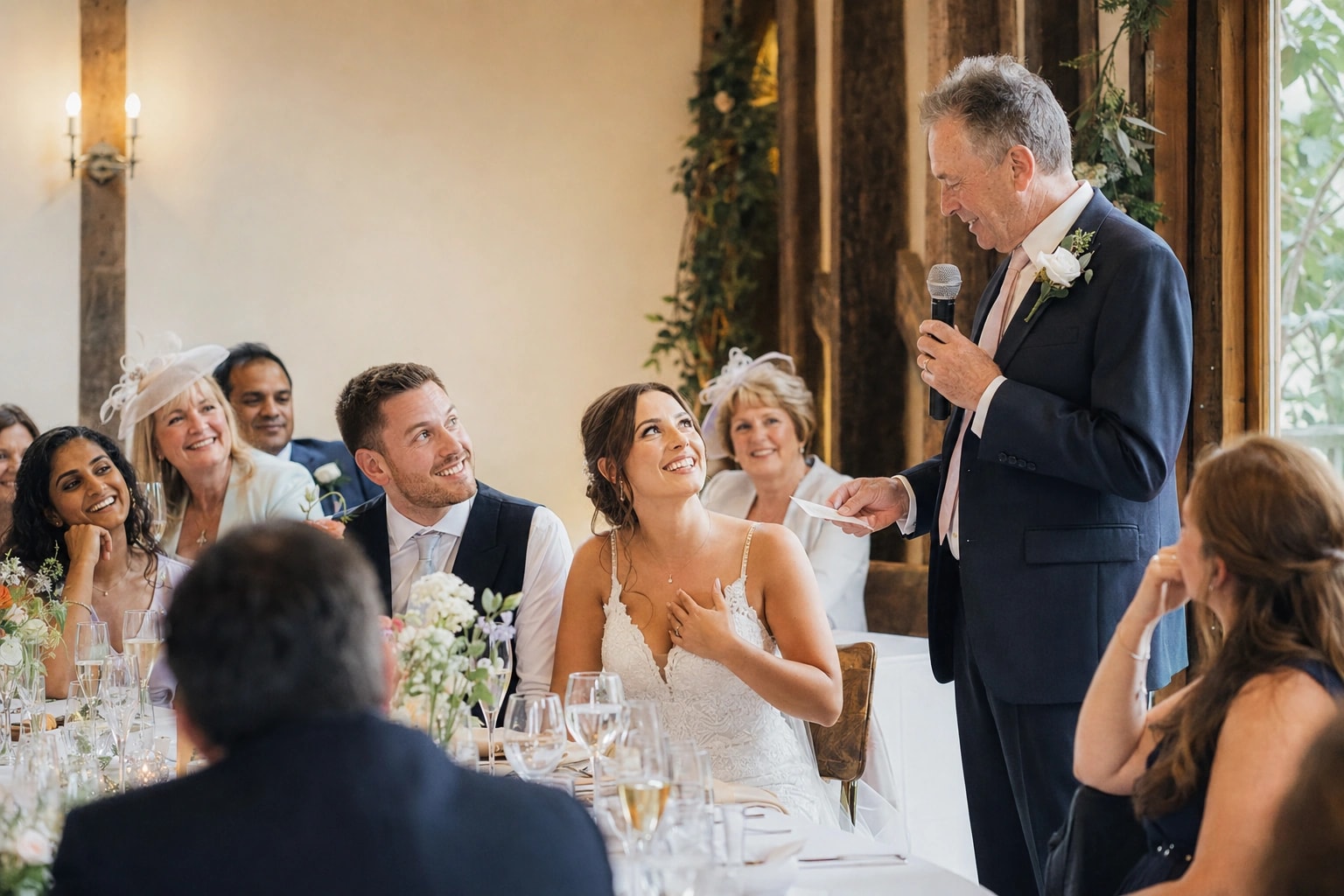
The role today
A father of the bride speech is about more than tradition
The role has a long history, but that does not mean your speech must sound as though it came from another generation. You are not required to describe yourself as giving your daughter away, approve somebody else’s choice or follow a fixed list of formal duties.
Your real value comes from perspective. You knew your daughter before most people in the room did. You have seen the qualities that emerged early, the moments that changed her and the person she has chosen to build a life with.
Some couples will enjoy familiar traditions and formal acknowledgements. Others will want something relaxed and contemporary. Ask what matters to them, then use tradition as a toolbox rather than a rulebook.
Find the heart of it
Choose memories that reveal the adult she became
A childhood story earns its place when it says something useful about the person sitting in front of you now. It might reveal her determination, instinct to care for others, refusal to be hurried or ability to turn a small mishap into a family legend.
Avoid attempting to summarise an entire childhood. One vivid moment, properly told, will usually mean more than a sequence of school years, holidays and achievements.
Ask yourself what the story proves. Does it show that she has always stood up for people? That she approaches every problem with alarming confidence? That the independence you once found exhausting became one of the qualities you admire most?
Fictional illustrative example
Connecting a childhood memory to the person she is now
“When Hannah was eight, she announced that she no longer needed help assembling anything. This was shortly before the bookshelf collapsed, gently but comprehensively, across her bedroom floor.”
“She did not cry, blame the instructions or abandon the project. She sat amongst the pieces, worked out what had gone wrong and started again.”
“Her practical skills have improved considerably, thankfully, but that determination has never left her: when something matters to Hannah, she gives it her whole attention and does not walk away when it becomes difficult.”
This is fictional illustrative writing. Your speech should use your own memories, details and family voice.
A reliable shape
Father of the bride speech format: a structure that feels natural
You do not need to follow this sequence rigidly, but it creates a useful emotional journey: welcome the room, speak about your daughter, include her partner and finish by celebrating them together.
- 01
Welcome the room in your own voice
Open simply and confidently. Thank guests for sharing the day where that feels appropriate, but avoid beginning with a long list of names and practical arrangements.
- 02
Say what the day means to you
Acknowledge the significance of seeing your daughter marry without relying on stock phrases. Pride, happiness, surprise and gratitude can all be expressed plainly.
- 03
Tell one revealing family story
Choose a specific memory that shows character: determination, kindness, humour, independence or the quality that has remained recognisable throughout her life.
- 04
Connect the memory to who she is now
Do not leave the story sitting in childhood. Explain what it tells you about the adult in front of you and why that makes you proud.
- 05
Speak directly and warmly about her partner
Share what you appreciate about them, what you have noticed in the relationship and how they support or understand one another.
- 06
Celebrate the couple rather than offering instructions
Good wishes usually land better than a lecture about marriage. Keep any advice brief, personal and lightly held.
- 07
Finish with a clear toast
Bring the focus fully onto the couple, say their names and ask the room to join you in wishing them well.
Include the whole relationship
Welcome her partner as a person, not a formality
The section about your daughter’s partner should contain more than their name and a conventional welcome. Think about the evidence you have seen: how they listen to her, encourage her, calm her, challenge her or make ordinary days better.
You do not need to claim that you knew instantly they were perfect. Honest warmth is stronger than exaggerated certainty. You might say when you first understood the seriousness of the relationship, what you have come to respect about them or what becomes visible when the couple are together.
“Welcome to the family” may suit your family perfectly. Alternatives include saying how glad you are that they are part of your lives, celebrating the connection between two families or recognising the home the couple have already created together.
Humour without embarrassment
Let her enjoy the joke as much as the room does
Family stories can be wonderfully funny because they come with years of detail and recognition. They can also become uncomfortable when a parent forgets that a wedding audience is different from a family kitchen.
Worth including
- A harmless childhood incident that reveals a quality she still has.
- Your own mistakes, worries or overreactions as a parent.
- A familiar habit she openly recognises in herself.
- A story that moves naturally from laughter into admiration.
- Enough context for guests who do not know the family history.
Usually best avoided
- Stories about bodily functions, puberty or intimate relationships.
- Ex-partners or comparisons with previous relationships.
- Comments about weight, appearance, fertility or having children.
- Private family conflict or material that requires explanation afterwards.
- Treating her partner as the outsider or the target of repeated warnings.
Traditional elements
Use the conventions that still carry meaning
A traditional father of the bride speech may welcome guests, mention absent family members, praise the bride, welcome her partner and raise the first toast to the couple. Any of those can still work well.
Problems arise when conventions are included automatically. A formal welcome may be unnecessary if somebody has already given one. A long list of thanks may repeat the speeches around you. Language about ownership, permission or giving somebody away may feel wrong for the couple.
Speak with the couple about the order of speeches and who is covering important acknowledgements. That allows you to retain the traditions they value without repeating material or imposing expectations they deliberately chose to leave behind.
Sensitive family moments
Acknowledge absence without letting it take over the celebration
A brief reference to a deceased or absent family member may be deeply meaningful. It may also be too difficult, too private or already covered elsewhere. Never surprise the couple with an emotional tribute on the day.
Agree the wording in advance. Often one direct sentence is enough: acknowledge the person, recognise what the day would have meant to them, then return gently to the couple and the celebration taking place.
In blended, separated or complicated families, avoid presenting one version of family life as the official one. Thank and acknowledge people according to the real relationships involved, not merely their traditional titles.
Speaking directly to her
Do not hide the sincere part behind another joke
Many fathers find it easier to tell stories than to say plainly what they feel. The speech becomes memorable when you eventually stop speaking about your daughter and speak to her.
You do not need ornate language. Say what you admire, what has made you proud or what you hope she understands about your relationship. One unguarded sentence will carry more weight than a paragraph of familiar wedding phrases.
Fictional illustrative example
A simple sincere turn
“Hannah, there are dozens of things I am proud of, but the one that matters most is the way people feel around you. You notice who has gone quiet, who needs bringing in and who could use a hand before they have asked for one.”
“Watching Daniel recognise that in you — and give the same care back — has been one of the great comforts and joys of being your dad.”
The final toast
Finish by placing the couple at the centre
Once you reach the toast, resist adding another story. Stand, pause, look towards the couple and use their names clearly so the room knows when to raise its glass.
Your wish can be traditional, humorous or completely straightforward. What matters is that it belongs to the speech you have just given and celebrates the life they are beginning together.
From memories to finished speech
How SpeechAnvil helps shape your father of the bride speech
The guided interview asks about your favourite memories, proudest moments, the person your daughter has become, her partner’s place in the family and what you see when the couple are together.
You also set the humour level, audience sensitivities, subjects that must remain off-limits and the target length. SpeechAnvil then creates a personalised plan and writes one sample moment so you can judge the tone before paying.
Start my father of the bride speech