
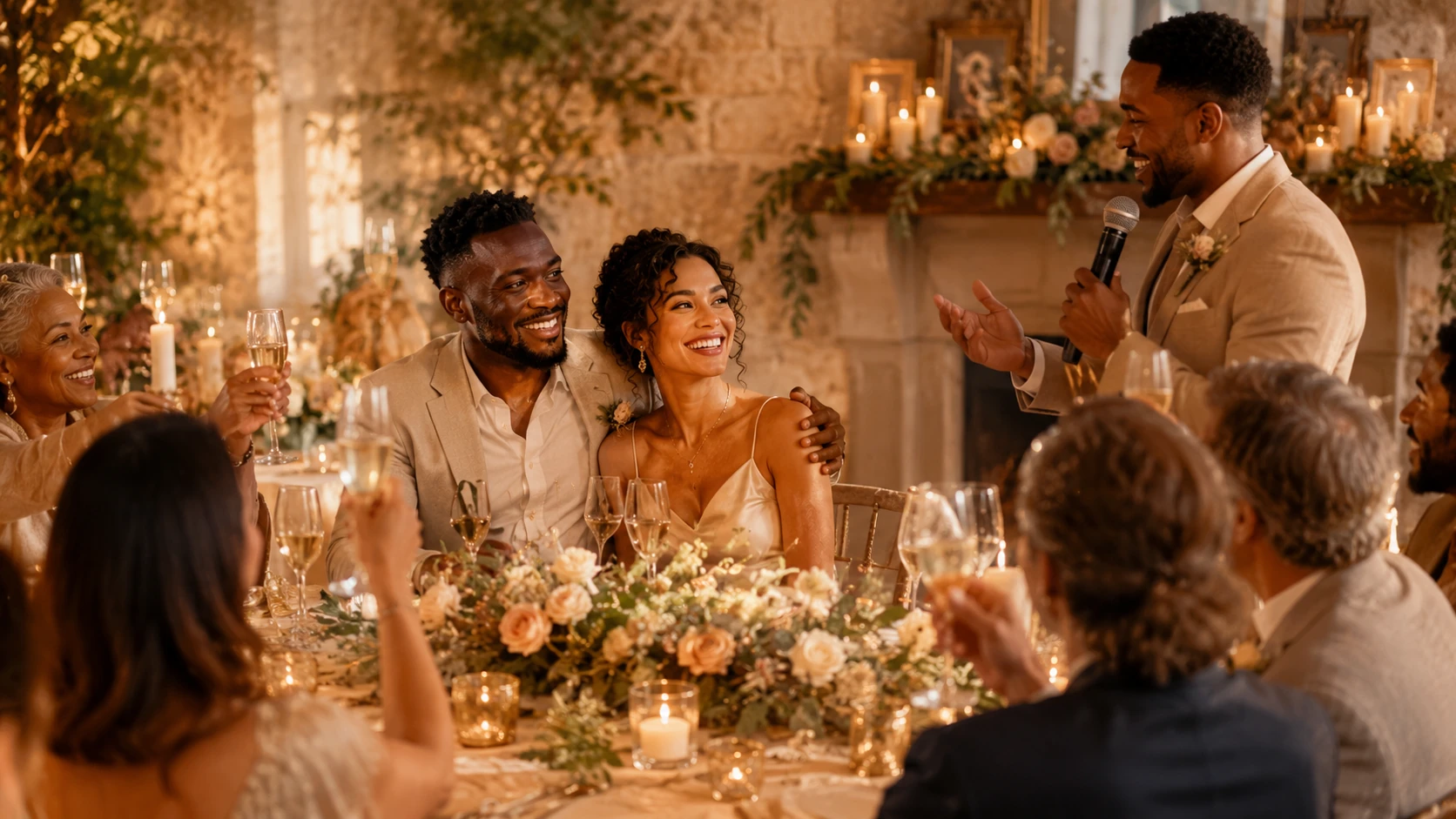
More than a number
The milestone gives the speech its occasion, not its whole meaning
Whether the couple are celebrating ten years, a silver anniversary, forty years, a golden anniversary or another significant point, the number deserves recognition. It represents time, commitment and a considerable amount of shared life.
But the speech should not become a calculation. Guests are not there simply to hear how many months, weeks or days have passed since the wedding. They want to recognise what happened during those years and the relationship that carried the couple through them.
Use the milestone as a frame. The real subject is the home, family, friendship, humour and ordinary companionship that developed inside it.
Find the relationship
Ask what makes these two people unmistakably themselves
Every long relationship develops its own language and rhythm. One person may plan everything while the other introduces an unexpected detour. One may speak to everybody in the room while the other remembers exactly what each person said.
Look for the pattern family and friends recognise immediately. It may appear in holidays, home improvements, family gatherings or the different ways the couple respond when something goes wrong.
That dynamic gives the speech a thread. Instead of presenting several unrelated memories, you can show the same partnership appearing in different forms across the years.
Fictional illustrative example
Capturing a couple’s familiar dynamic
“David has always believed that a journey begins when the car leaves the drive. Meena believes it begins three weeks earlier, with a folder, a packing list and independent verification of the hotel’s breakfast arrangements.”
“On their first holiday together, David arrived with a small bag and the confidence that anything forgotten could be bought locally. Meena arrived with spare batteries for equipment neither of them owned.”
“Forty years later, the luggage has become lighter and the folders have moved onto a tablet, but the partnership remains the same: Meena makes sure they are prepared, and David makes sure the plan contains at least one story worth telling afterwards.”
This is fictional illustrative writing. Your speech should use the couple’s real habits, history and family voice.
A dependable shape
An anniversary speech structure that honours both the past and present
This structure moves from the milestone into the couple’s story, reveals what they are like together and finishes by recognising what their relationship has meant to other people.
- 01
Acknowledge the milestone
Open with the anniversary being celebrated and the significance of everybody gathering to recognise it.
- 02
Explain your connection to the couple
Briefly establish the perspective from which you know them, whether as family, a friend or somebody who has shared part of their journey.
- 03
Return to an early chapter
Tell a concise story about how they met, their early relationship or a moment when people realised they were serious.
- 04
Show what they are like together
Use one revealing story or observation to capture their habits, contrasts, humour or way of supporting one another.
- 05
Recognise what the years contain
Acknowledge the home, family, friendships, challenges or shared experiences they built without trying to list everything.
- 06
Say what their relationship means to others
Explain what family and friends have learned, received or witnessed through knowing the couple.
- 07
Finish with both partners
Use both names, make one sincere wish and invite the room to raise a glass.
The early years
Tell the beginning without pretending it was a legend
Stories about how a couple met can be delightful, particularly when later generations have heard several competing versions. Use the account the couple themselves recognise, and be honest where details have become uncertain.
The beginning does not need to sound like destiny. An awkward first date, missed opportunity or slow-growing friendship may say more about the real relationship than a polished claim that everybody knew immediately.
Keep this section proportionate. The anniversary celebrates the whole life that followed, not only the circumstances that brought them into the same room.
Choosing stories
Select moments that reveal how they work as a couple
The strongest anniversary stories usually involve both partners. A story about only one person may be entertaining, but it should lead towards something about the relationship.
Look for moments involving shared decisions, competing approaches, unexpected difficulties or the domestic routines that became family folklore. Give enough context for guests who were not there.
Worth including
- A story both partners already enjoy retelling.
- A moment showing how their different qualities work together.
- Specific details that family and friends will recognise.
- A shared plan, journey or project that became memorable.
- Humour that leads naturally towards admiration.
Usually best avoided
- A story that makes one partner the permanent fool.
- Private arguments or unresolved family conflict.
- Material that only one partner finds funny.
- Long explanations involving people the guests do not know.
- Several stories that all make the same point.
Humour built over years
Let familiarity create recognition rather than contempt
Long relationships produce excellent material: repeated discussions, predictable packing habits, unfinished projects and the sentence one partner can complete before the other has reached the second word.
Affectionate humour shows that the speaker knows the couple. Cynical humour suggests that staying together is inherently miserable or that one partner has spent decades tolerating the other.
Avoid familiar lines about marriage being a prison, one spouse always being right or the secret of a long relationship being separate televisions. Unless such a line reflects this particular couple, it will sound borrowed.
Worth including
- Contrasting habits both partners openly recognise.
- Domestic routines that became part of family life.
- Plans that reliably unfold in their characteristic way.
- How the couple have adapted to changing technology or fashions.
- A joke that leaves both partners looking loved.
Usually best avoided
- Marriage presented as endurance, defeat or imprisonment.
- Jokes suggesting one partner controls or fears the other.
- Ex-partners, infidelity or private relationship history.
- Comments about appearance, health, intimacy or ageing bodies.
- Claims that one person deserves praise merely for staying.
What the years contain
Recognise the shared life without producing a family inventory
A long relationship may contain several homes, careers, children, friendships, losses, celebrations and changes nobody could have predicted on the wedding day.
You do not need to mention each one. Choose the developments that help explain the couple’s life and the effect they have had on the people around them.
An adult child may talk about the atmosphere their parents created at home. A friend may describe the couple’s hospitality or loyalty. A sibling may recognise the way two families gradually became connected.
Fictional illustrative example
Celebrating the life around the relationship
“David and Meena did not merely build a home for themselves. They created the house where people knew they could arrive early, stay late and open the fridge without asking.”
“It became the place for birthdays, difficult conversations, emergency childcare and meals that began with four people and ended with twelve.”
“That welcome is part of their marriage. The life they built together has always had room for the rest of us.”
Challenges and resilience
Acknowledge strength without exposing private history
The years may have included bereavement, illness, financial pressure, family difficulties or other periods that tested the couple. These experiences may be central to their story, but they do not automatically belong in a public speech.
Ask both partners before referring to anything sensitive. They may be comfortable with a broad acknowledgement of difficult years while preferring the details to remain private.
Avoid language suggesting hardship is proof of a better marriage. Recognise the care, patience or courage the couple showed without romanticising what they endured.
The supposed secret
Offer an observation, not a universal lesson about marriage
Anniversary speakers are often tempted to explain the secret of a lasting relationship. The couple themselves may have a funny or thoughtful answer, and it can provide an excellent part of the speech.
But no single formula explains a life together. Rather than presenting the couple as proof of a rule, describe what you have actually seen: patience, independence, shared values, stubborn loyalty, frequent laughter or the willingness to repair things after they go wrong.
The observation should belong to this couple rather than sounding like advice copied from a greetings card.
Fictional illustrative example
An observation about why the relationship lasts
“People sometimes ask for the secret of forty years together. I doubt David and Meena would agree on a single answer.”
“But those of us who know them have seen something consistent. They make room for one another to remain separate people, while never leaving the other person to face the important things alone.”
“That may not fit neatly onto an anniversary card, but it has built a remarkable marriage.”
Different speakers
Use the perspective only you can provide
An adult child can describe the relationship as part of family life. A lifelong friend may remember the couple before many other guests knew them. A sibling may see how one partner became woven into the wider family.
Do not attempt to represent every person in the room. Speak from what you witnessed and allow other guests to recognise their own experiences through it.
Where several people are speaking, divide the material in advance. One speaker might cover the early years while another focuses on family life or the couple today.
Anniversary traditions
Use silver, ruby or gold as a detail rather than a complete theme
Traditional anniversary materials can provide a useful opening image or final line. Silver may suggest something polished through use, while gold can reflect value that deepened over time.
Keep the comparison light. An extended explanation of traditional gifts can quickly feel less personal than the real stories available to you.
The couple may not care about the traditional name at all. Their own description of the milestone should take priority over inherited symbolism.
The final toast
Address both partners and the life between them
Bring the speech fully into the present. Look towards the couple, use both names and say what their relationship has meant to you, their family or the wider group gathered around them.
Offer one clear wish for the years ahead and invite everybody to raise a glass. Once the room responds, resist returning to another story.
From shared history to finished speech
How SpeechAnvil creates your anniversary speech
The guided interview asks how long the couple have been together, how they met, what they are like together, which experiences shaped them and what friends or family believe has helped the relationship last.
You can add the stories, familiar habits and sensitive boundaries that make the speech personal. You also choose the humour level and target length.
SpeechAnvil then creates a personalised plan and one fully written sample moment, allowing you to judge the structure and tone before deciding whether to buy the completed speech.
Start my wedding anniversary speech