
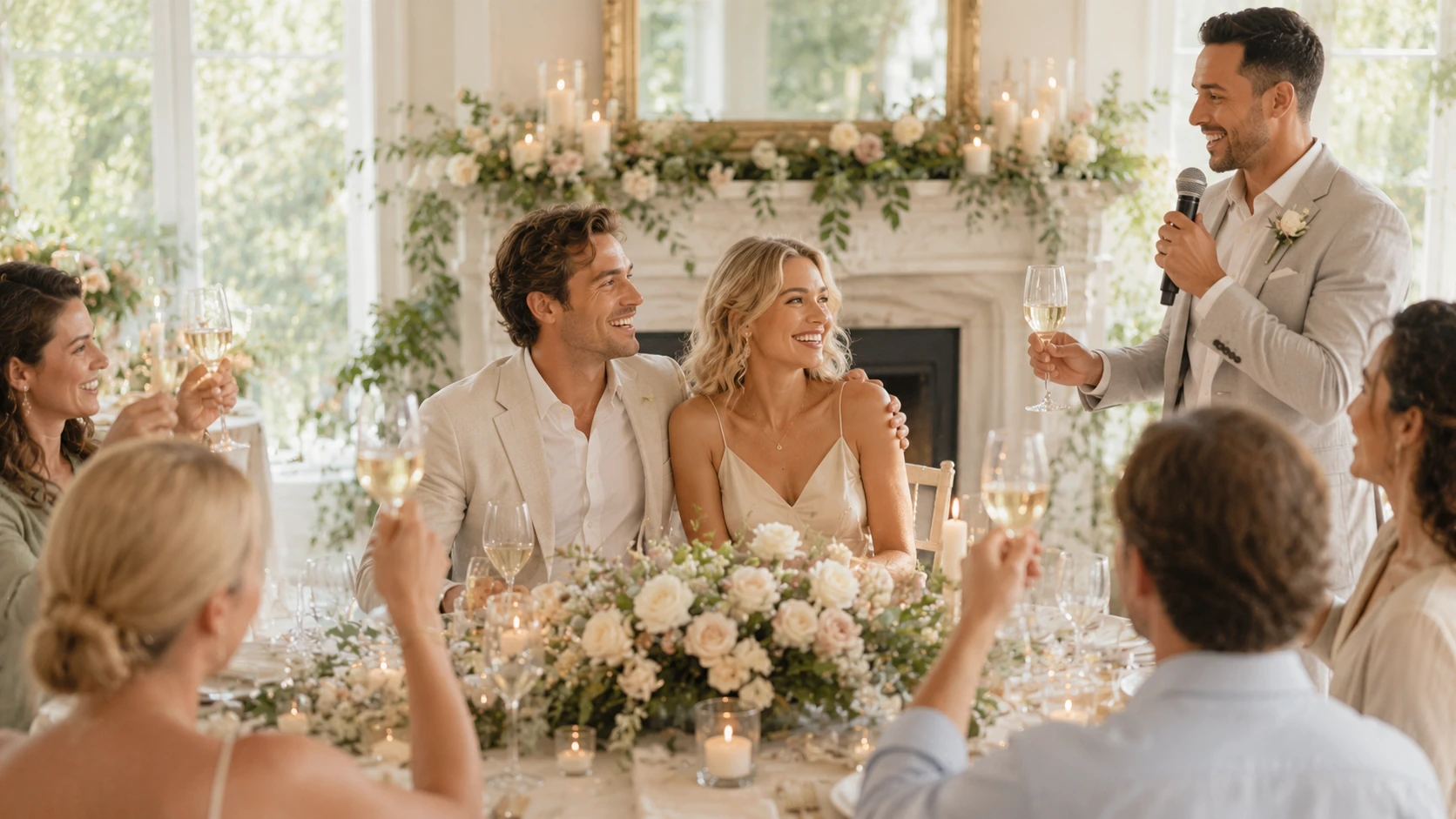
The real job
A best man speech is not an evidence file against the groom
The stories may be the part everybody anticipates, but the purpose is not to prove that you possess damaging information. Your job is to help the room recognise the person you know, celebrate the relationship and give the couple a few minutes they can genuinely enjoy.
That leaves plenty of room for jokes. The difference is that the humour comes from affection and recognition rather than exposure. The person getting married should be able to laugh because the story feels true, not sit waiting to discover what you reveal next.
A strong test is whether the speech would still feel worth giving if one of the jokes received no laugh. There should still be friendship, insight and something meaningful to say about the couple.
Choose the right material
The best story is not always the most outrageous one
Look for incidents with recognisable character. Perhaps your friend became hopelessly overconfident, tried to help and made everything worse, refused to admit being lost or displayed an oddly impressive commitment to a terrible idea.
The story needs enough context for relatives and guests who were not there. Tell the audience where you were, what was supposed to happen, what went wrong and the detail that makes the ending funny.
Then decide what the story reveals. Loyalty, optimism, stubbornness, generosity and misplaced confidence can all become bridges from humour into something affectionate.
Fictional illustrative example
A story that reveals more than the mishap
“Tom once volunteered to organise our entire weekend in Edinburgh. He produced a colour-coded itinerary, train times, restaurant bookings and a walking route accurate to the nearest six minutes.”
“By half past ten on Saturday morning, the restaurant had closed three years earlier, the walking route had taken us through a locked university courtyard and Tom was insisting the rain was ‘not part of the core plan’.”
“But this is the thing about Tom: when his plans collapse, he never disappears. He stays, apologises, finds somewhere else and somehow makes the disaster more memorable than the weekend he intended.”
This is fictional illustrative writing. Your speech should use the real details, language and rhythm of your friendship.
A dependable shape
A best man speech structure that keeps moving
The structure below gives the speech momentum without making it sound formulaic. It begins with your friendship, earns the humour and then turns naturally towards the couple.
- 01
Open simply and settle the room
Introduce yourself where necessary and begin with a line you can deliver naturally. You do not need an elaborate joke before the audience knows why you are speaking.
- 02
Establish the friendship
Briefly explain how you know the person getting married and what gives you the right to tell these stories. Keep the autobiography short.
- 03
Tell the strongest story first
Choose a specific incident with clear details, a turning point and a reason the audience can recognise the person in it.
- 04
Use a second story only if it adds something
The next story should reveal a different quality or show a change over time. Do not repeat the same joke in a different setting.
- 05
Bring in the partner properly
Explain what you noticed when the relationship became serious, what changed or why the two people work well together.
- 06
Say the sincere thing
Speak plainly about the friendship and the couple. A short honest paragraph gives the jokes somewhere meaningful to land.
- 07
Finish with the couple and the toast
Use both names, make one clear wish for their future and invite the room to raise a glass.
Humour with limits
Make the subject feel known, not ambushed
The difference between affectionate teasing and humiliation often lies in consent, context and consequence. A story may be famous amongst close friends but completely unsuitable in front of family, colleagues and somebody’s new in-laws.
Ask whether the person already laughs about it, whether the partner knows it and whether telling it changes how anybody in the room sees them. When in doubt, choose the safer story and tell it better.
Worth including
- Stories the person already tells about themselves.
- Harmless overconfidence, familiar habits and failed plans.
- Jokes that are clear to guests who were not there.
- A little self-mockery so the teasing does not feel one-sided.
- Humour that leads naturally into loyalty, friendship or affection.
Usually best avoided
- Ex-partners, infidelity or private relationship history.
- Sexual stories or material intended to shock older relatives.
- Illegal behaviour, drugs or incidents involving serious consequences.
- Appearance, weight, fertility, health or financial problems.
- Anything the subject has asked you not to mention.
Including the partner
Do not let the relationship arrive in the final thirty seconds
A common weakness in best man speeches is spending almost the entire time on the friendship, then suddenly remembering that a wedding has taken place. The partner deserves more than a name inserted before the toast.
Think about when you first understood that the relationship mattered. What changed in your friend? What did you notice about the way they behaved together? What does the partner understand, encourage or steady that other people may not?
You do not need to claim that the partner transformed or rescued your friend. A better approach is to show what becomes visible when the two people are together.
Fictional illustrative example
Moving from friendship towards the couple
“For years, Tom treated making plans as a competitive sport. Then he met Maya, who somehow became the first person capable of asking, ‘Have you actually checked that place still exists?’ without starting a forty-minute defence of the spreadsheet.”
“Maya does not stop Tom dreaming up plans. She makes the plans better, and Tom has never looked more himself than he does when the two of them are working something out together.”
Handling tradition
Keep the formal elements only where they help
Traditional best man speeches may include acknowledgements of the wedding party, messages from absent guests and compliments directed towards bridesmaids. None of these elements is compulsory.
Check the speech order with the couple. Somebody else may already be handling the welcome and thanks, and repeating them can drain energy from the room. Include an acknowledgement because it means something, not because an old checklist says it belongs to your role.
Compliments should be directed at people as participants in the day, not as decorations. Thank somebody for friendship, support, organisation or the atmosphere they helped create rather than commenting collectively on appearance.
The sincere turn
Give the friendship somewhere to land
After the jokes, say why you value the person. This does not need to become sentimental or lengthy. You may admire their loyalty, the way they appear when somebody needs help or the fact they have remained beside you through parts of life that are not funny enough for a wedding speech.
Speak directly for a moment rather than continuing to narrate for the room. The contrast between humour and one honest sentence often creates the strongest point in the speech.
Fictional illustrative example
A short, direct moment between friends
“Tom, I have taken every available opportunity today to discuss your weaknesses, so I should probably acknowledge the thing the jokes leave out.”
“You are the person who turns up. Not only when there is a good night planned, but when somebody is struggling, embarrassed or unsure what to do next. I have benefited from that friendship more times than I could explain here.”
The toast
Finish before the speech starts looking for another ending
Once you have reached the couple, stay there. Do not return to another anecdote or attempt to beat your biggest laugh. The toast should feel like the destination of the speech rather than an administrative requirement.
Say both names clearly, ask the guests to raise their glasses and offer one concise wish for the future. Pause after the toast and let the room respond.
Practise the actual delivery
A funny line needs room to be heard
Nervous speakers often rush the setup, speak over the audience’s reaction and weaken the next line. Read the speech aloud and mark where you need to pause, breathe or look towards the couple.
Time it at a natural pace rather than racing to prove it is under five minutes. A pause after a joke is part of the running time, and a sentence delivered calmly will usually feel shorter than one delivered in a breathless hurry.
SpeechAnvil’s Rehearsal Studio provides a teleprompter, timer and recorder, allowing you to practise the finished speech several times before giving it in front of the wedding guests.
From stories to finished speech
How SpeechAnvil builds your best man speech
The interview asks how you know the person getting married, which stories the friendship group always tells, where their confidence exceeds their ability and what changed when they met their partner.
You choose the humour level, identify sensitive subjects, set the target length and explain what you genuinely admire. SpeechAnvil then creates a personalised plan with one fully written sample moment so you can judge the tone before paying.
Start my best man speech