
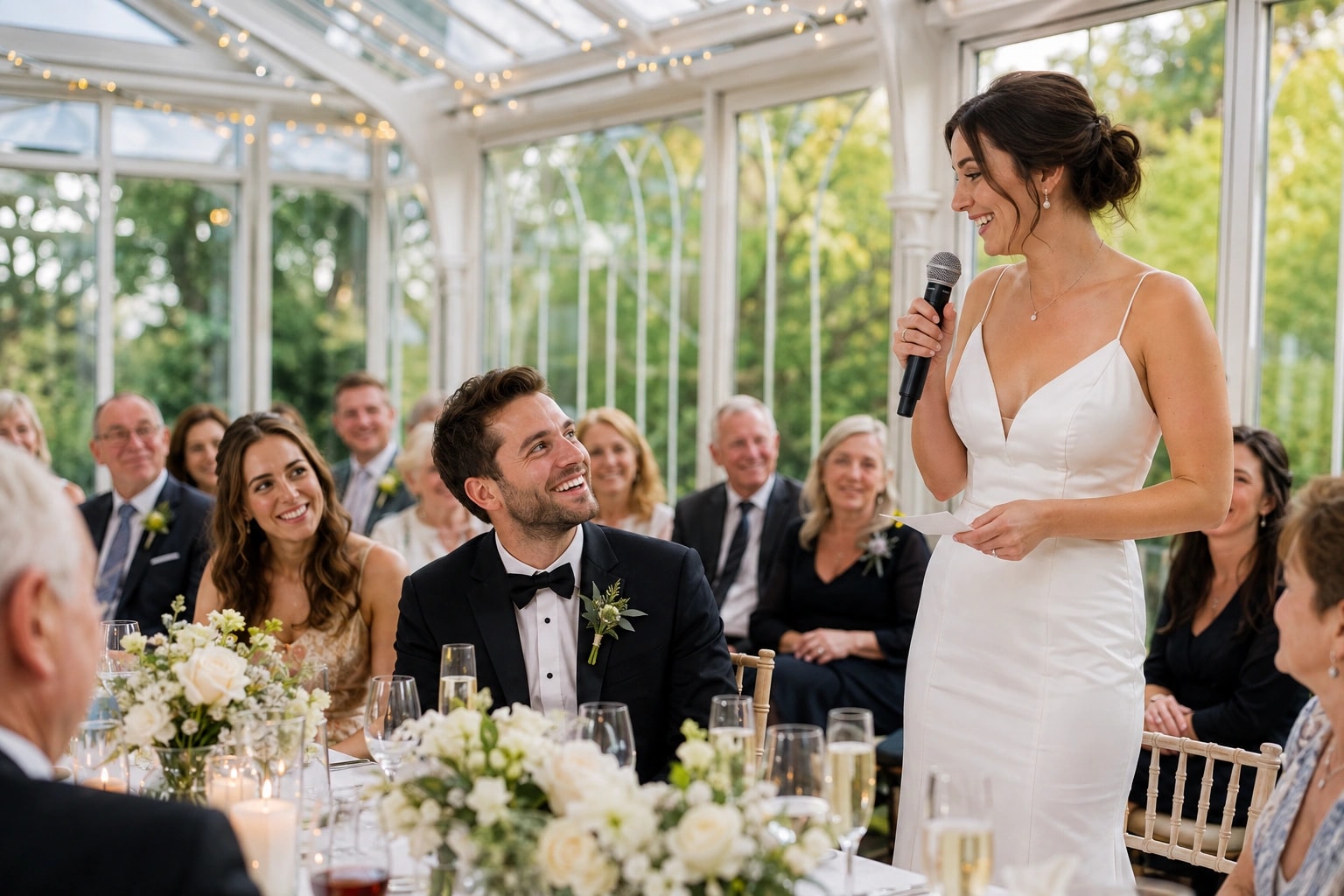
Your voice belongs in the room
A bride does not need permission or tradition to give a speech
Older wedding conventions often gave the bride a central ceremonial role but very little opportunity to speak. Other people welcomed the guests, described her childhood, thanked the wedding party and spoke about the marriage on her behalf.
That arrangement is optional. You may want to thank people in your own words, tell a story nobody else can tell or speak directly to your spouse in front of the people who helped bring both of you to this point.
You do not need to explain why you are giving a speech. Stand, welcome the room and begin. The speech belongs because you have something worth saying.
Choose your focus
Decide what only you can add to the speeches
Other speakers may already be covering childhood stories, family welcomes or friendship-group adventures. Your strongest material is often the part of the day and relationship seen from inside it.
You know the conversations behind the decisions, the ordinary moments that changed the relationship and the qualities your spouse shows when nobody else is watching.
Choose one central purpose. You might want to thank the people who supported you, explain what your spouse has brought into your life or describe what it means to see everybody gathered together.
A relaxed beginning
Open with recognition rather than a rehearsed wedding joke
The opening only needs to settle you and the audience. You might acknowledge how strange it feels to see so many parts of your life in one room, thank everybody for sharing the day or make a small observation about something that has already happened.
Avoid spending the first minute apologising for speaking, announcing that brides do not normally give speeches or warning everybody that you are nervous. Those remarks make the moment seem unusual when it does not need to be.
Fictional illustrative example
A confident but natural opening
“Thank you all for being here. Seeing childhood friends, relatives, colleagues and people who know completely different versions of us gathered in one room is both wonderful and slightly alarming.”
“Daniel and I feel extraordinarily lucky to have so many people we love sharing this day — including those of you who travelled a long way and those who have spent the last six months answering messages beginning with, ‘Just one quick wedding question.’”
This is fictional illustrative writing. Your speech should reflect your own relationship, guests and natural voice.
A dependable shape
A bride speech structure that keeps your spouse at its centre
This structure gives gratitude, storytelling and the relationship enough room without making the speech feel like a formal checklist.
- 01
Begin in your own voice
Welcome the room or acknowledge the moment simply. You do not need to justify why the bride is speaking.
- 02
Thank people with purpose
Group acknowledgements around the support people gave rather than reading a long list of names.
- 03
Share your perspective on the day
Say what it feels like to see different parts of your lives gathered together and what the celebration means to you.
- 04
Tell one relationship story
Choose a moment that reveals your spouse’s character or explains when the relationship began to feel important.
- 05
Speak directly to your spouse
Move from describing them to addressing them. Say what you admire and what life beside them has come to mean.
- 06
Look towards the future
Offer a brief thought about the life ahead without turning the speech into a second set of vows.
- 07
Finish with a clear toast
Invite the guests to celebrate your spouse, your marriage or everybody who has shared the day.
Giving thanks
Thank people for what they did, not merely because they are listed
A bride speech can easily become a second round of acknowledgements already made by parents or a spouse. Coordinate with the other speakers before the wedding so each person has a clear purpose.
Group people by the role they played. Thank friends who protected your sanity, relatives who provided practical help, guests who travelled and members of the wedding party who stood beside you throughout the preparations.
One specific detail will make a group acknowledgement feel personal. Explain what their help changed, solved or made possible.
Worth including
- People whose emotional or practical support genuinely mattered.
- Guests who travelled a significant distance to attend.
- Friends who helped during difficult or stressful moments.
- Family relationships that are meaningful to you and your spouse.
- Short details showing why each acknowledgement belongs.
Usually best avoided
- Reading a complete directory of everybody involved.
- Repeating thanks already covered by another speaker.
- Making one family or friendship group sound more important.
- Naming suppliers unless there is a personal reason to do so.
- Turning the speech into wedding-day administration.
Your relationship story
Choose an ordinary moment that explains something important
The story does not need to be the proposal, the first date or an expensive holiday. Relationships often become clearest in much smaller moments: a difficult journey, a quiet act of support or a day when plans disappeared and you discovered how well you worked together.
Describe the scene briefly, include the detail that makes it recognisable and explain what it showed you about your spouse.
Fictional illustrative example
A relationship story built from an ordinary day
“One Sunday, shortly after Daniel and I moved in together, the washing machine flooded the kitchen, the electricity stopped working and we discovered that neither of us knew where the stopcock was.”
“I stood in the hallway holding every towel we owned while Daniel searched online for diagrams that seemed to belong to a completely different house.”
“Nothing about that afternoon was impressive, but somewhere between the wet floor and the emergency trip to the hardware shop, I realised how calm life felt with him beside me. Not because things stopped going wrong, but because problems became something we faced together.”
Humour that belongs to you
Let the jokes reveal the relationship rather than undermine it
A bride speech can be funny without copying the familiar jokes found in traditional groom or best-man speeches. The most natural humour usually comes from your own habits, your shared plans and the small differences between you.
Make yourself the target sometimes. It keeps the humour balanced and stops your spouse feeling as though they have become material for a surprise comedy routine.
Worth including
- Your own wedding-planning mistakes or overreactions.
- Shared habits both of you openly recognise.
- Affectionate contrasts between your personalities.
- A plan that failed but became a favourite memory.
- Humour that creates a natural path into sincerity.
Usually best avoided
- Private arguments or unresolved relationship tensions.
- Ex-partners, sexual material or intimate history.
- Jokes about marriage ending freedom or independence.
- Comments about appearance, fertility or having children.
- Anything your spouse has asked you not to mention.
Speaking to your spouse
Stop addressing the room for a moment
At some point, turn towards your spouse and speak directly. The tone may become quieter and more personal, but it does not need to resemble a second set of vows.
Say what you admire, what you have learned from them or what everyday life together has come to mean. Specific qualities and actions will feel more intimate than familiar romantic phrases.
Fictional illustrative example
A direct tribute to a new spouse
“Daniel, you are generous in ways that rarely attract attention. You remember when somebody has an important appointment, notice when I am pretending not to worry and quietly make difficult days easier without expecting credit.”
“You make me laugh, but you also make me feel safe enough to be completely serious. Being loved by you has made my life steadier, kinder and much more fun.”
“Today has been extraordinary, but it is the ordinary days beside you that I am most excited to keep choosing.”
Families and sensitive relationships
Use wording that reflects your actual life
Your family may include parents, stepparents, adoptive relatives, guardians, close friends or people whose importance cannot be captured neatly by a traditional title.
Acknowledge people according to the relationships that matter, not according to an inherited wedding script. You do not need to explain private family history to the room.
Agree references to bereavement, separation, illness or difficult relationships with your spouse beforehand. A brief acknowledgement may be meaningful, but an unexpected emotional tribute can change the atmosphere for everybody involved.
When both spouses speak
Make the speeches complementary rather than identical
When both newlyweds give speeches, divide the formal responsibilities beforehand. One person might welcome guests while the other thanks the wedding party. Each can speak about the other from their own perspective.
Avoid telling the same relationship story or repeating the same names. The two speeches should feel connected without sounding like separate versions of one script.
You may also choose to give a joint speech. That works best when each person owns complete sections rather than alternating every sentence.
The final toast
Let the ending belong to the relationship
Finish by bringing the room back to your spouse and the marriage you are celebrating. Make one clear wish, ask everybody to raise their glasses and allow the response to complete the moment.
Do not return to another list of thanks or a final anecdote after the toast. A confident ending is partly knowing when to stop.
Delivery
Practise until you can look up and enjoy the moment
You do not need to memorise every word, but you should understand the route through the speech. Read it aloud several times, mark your pauses and simplify any sentence that does not sound like you.
Decide where you want to look towards your spouse, family and guests. Those moments of eye contact will make the delivery feel more personal than perfect memorisation.
SpeechAnvil’s Rehearsal Studio includes a teleprompter, timer and voice recorder so you can practise the finished speech at a natural pace before the wedding.
From your memories to a finished speech
How SpeechAnvil helps create your bride speech
The guided interview asks about your spouse, your relationship story, the people you need to thank, the tone of the wedding and the moments you most want to include.
You choose the humour level, identify sensitive subjects and set the target length. SpeechAnvil then creates a personalised plan and one fully written sample moment, allowing you to judge the tone before deciding whether to buy the complete speech.
Start my bride speech