
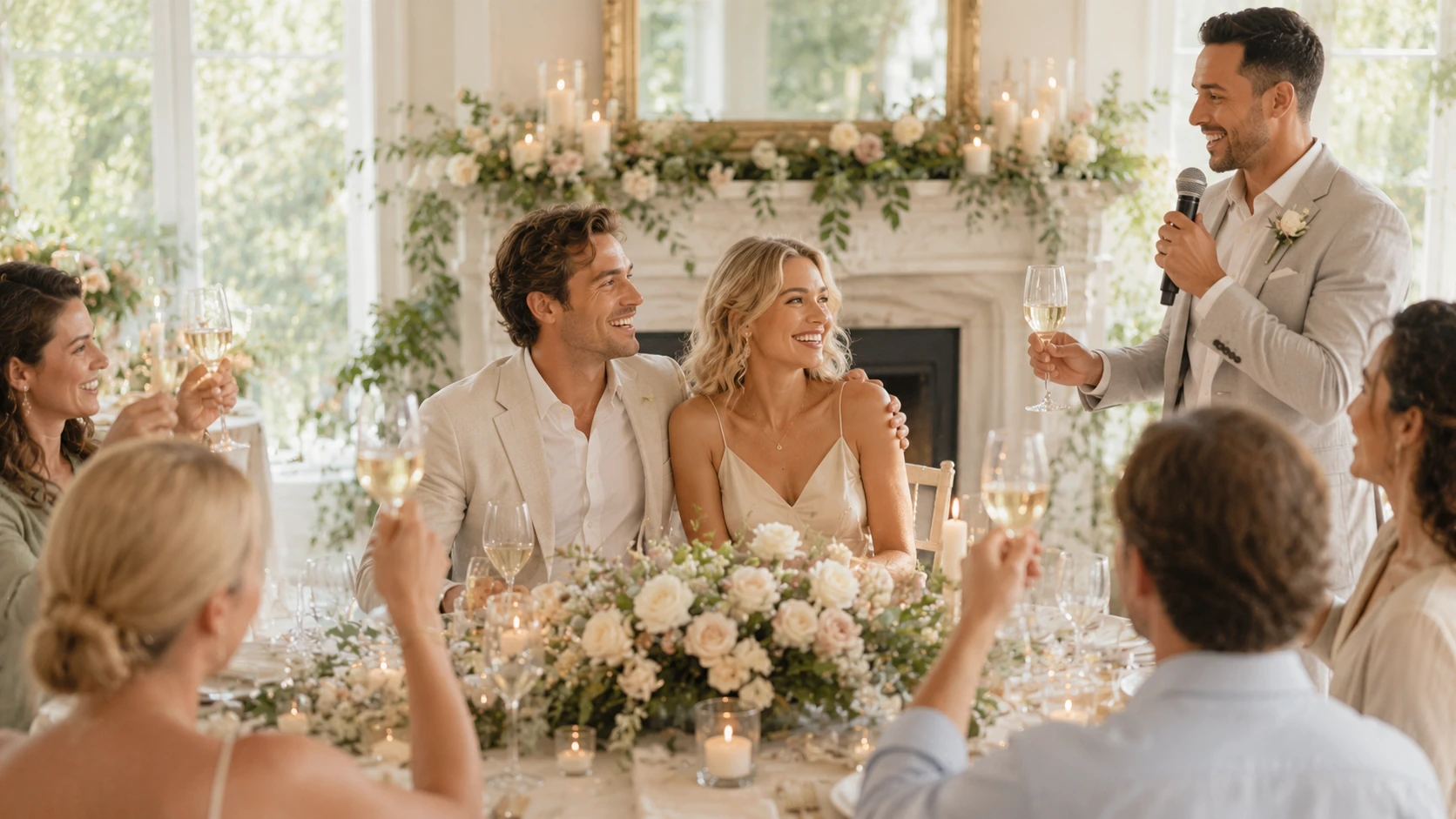
"Who speaks first?" is one of the most-asked questions in wedding planning - and the answer is part tradition, part common sense, and increasingly up to you. Here's how it works.
The traditional UK order
- Father of the bride - opens the speeches, welcomes guests and toasts the couple.
- The groom - responds on behalf of the couple, thanks everyone and traditionally toasts the bridesmaids.
- The best man - traditionally rounds things off, bringing the humour and a final toast.
This order has a logic to it: it moves from the host, to the couple, to the entertainment - building toward the best man's speech as the finale.
How modern weddings have changed it
Today, the line-up is far more flexible and inclusive. It's now completely standard to add:
- The bride, speaking for herself - now a familiar part of many modern weddings.
- The maid or man of honour - an increasingly popular addition to the traditional line-up.
- The mother of the bride, or both mothers.
- Both partners together, or same-sex couples arranging the order however suits them.
There's no rule you have to follow. The only real principle is that it should feel natural and balanced for your families.
Practical tips for a smooth run
- Keep the total under 30 minutes. Four or five speakers at five minutes each is plenty.
- End on a high. Put your funniest or most moving speaker last.
- Tell everyone the order in advance, so nobody's caught off guard or talks over the person before them.
- Consider timing it before the meal, so speakers can relax and eat afterwards - a popular modern choice.
However you arrange it
Whoever is speaking, SpeechAnvil has guides for every role - from the father of the bride and groom to the bride, best man and maid or man of honour. Each speech is built around the speaker, the couple and their real stories - never a generic template.