
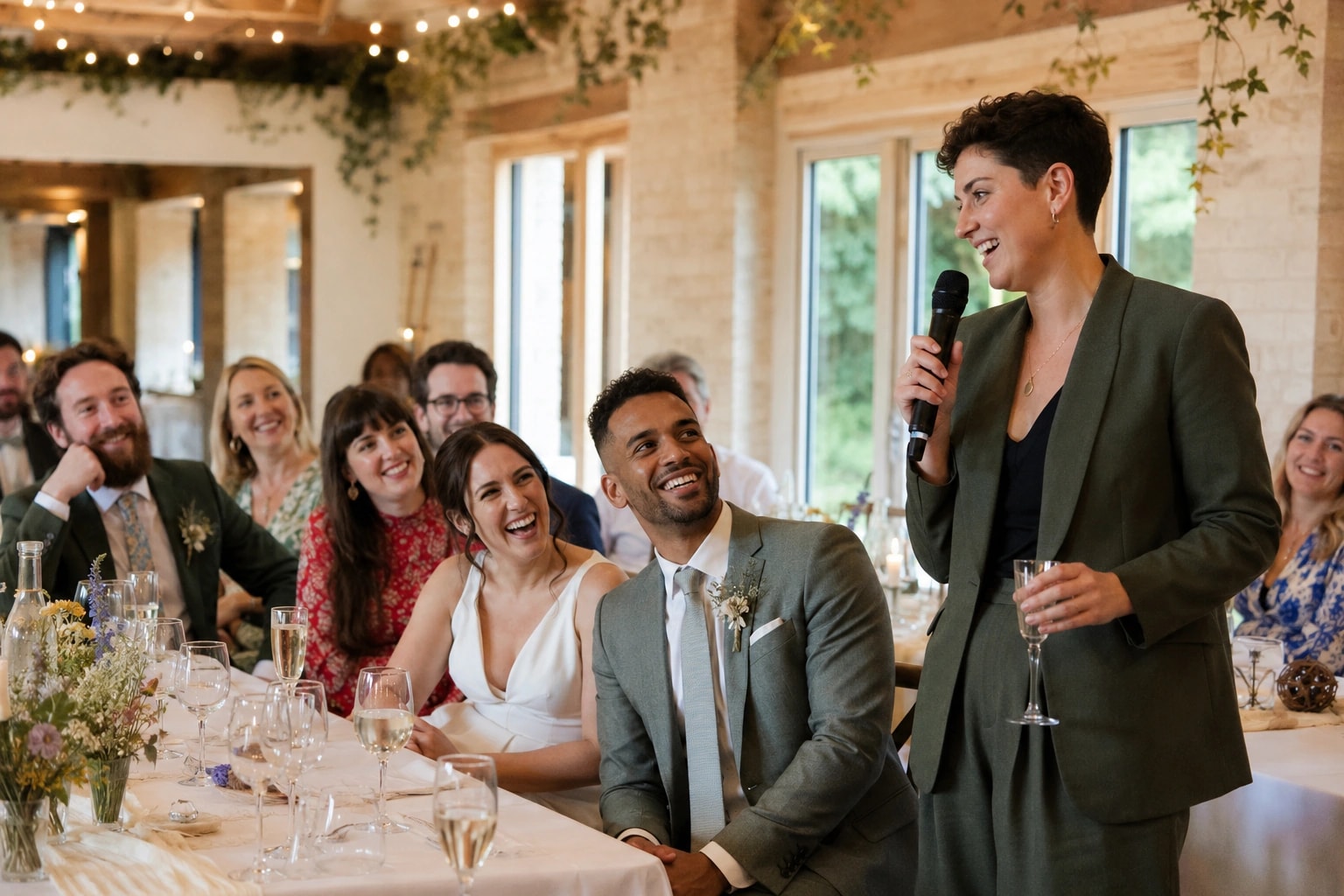
Your version of the role
The title does not have to determine the speech
Best woman and best person are modern titles, but the value of the role is not new. You are somebody the person getting married trusts to stand beside them, support them and speak about them in front of the people who matter.
That does not require you to reproduce the familiar best man routine: a formal introduction, escalating embarrassment, a sudden sentimental paragraph and a toast. You may use parts of that shape where they suit you, but the speech should grow from the relationship that actually exists.
You might be a lifelong friend, sibling, university flatmate, colleague or relative. You may have years of chaos to draw on, or a quieter friendship built through difficult periods and ordinary loyalty. Both can produce a memorable speech.
Best woman or best person?
Use the title that feels right to the people involved
Some speakers prefer best woman because it describes them while preserving a familiar wedding role. Others choose best person because it feels more natural, inclusive or accurate. Some couples invent their own title entirely.
You do not need to justify the wording unless there is a story worth telling. A simple introduction such as “For anyone I have not met, I’m Leah, Sam’s best person and oldest friend” gives the room everything it needs.
SpeechAnvil supports best woman and best person as separate interview choices. The button on this page starts the wedding interview, where you can select the title you are using.
Find your material
Choose stories that depend on your particular perspective
The strongest material is not merely something funny that happened. It is a story that sounds different because you are the person telling it. You know the missing detail, the repeated habit or the explanation behind a decision that other guests only saw from the outside.
Look for moments when your friend became unmistakably themselves: overcommitting to a plan, helping somebody without making a fuss, refusing to give up, becoming competitive over something trivial or quietly keeping everybody together.
A good story creates recognition across the room. Close friends know the behaviour already; newer relatives and guests understand it by the end.
Fictional illustrative example
A story built around a recognisable quality
“When Erin says, ‘Leave it with me’, there are two things you can rely on. The problem will be solved, and at least three entirely unrelated problems will somehow become part of the solution.”
“When our train was cancelled in York, Erin found another route, booked a table for six people we had never met and persuaded a hotel receptionist to store a birthday cake that belonged to somebody else.”
“It was chaotic, generous and far more complicated than necessary — which is also a fairly accurate description of how Erin looks after the people she loves.”
This is fictional illustrative writing. Your version should use the real details and language of your relationship.
A useful shape
A speech structure led by friendship rather than convention
This structure gives the audience enough context, allows the stories to build and moves towards the couple before the final toast.
- 01
Introduce the relationship
Give the room enough context to understand who you are and how you became important to the person getting married. Avoid turning the introduction into your own life story.
- 02
Choose a story that could only come from you
Use a moment that reflects your particular friendship or family relationship rather than searching for a conventional wedding anecdote.
- 03
Reveal the quality behind the story
Let the humour show something recognisable: loyalty, determination, generosity, chaos, optimism or the habit that everybody close to them knows.
- 04
Bring in the partner before the ending
Explain what you noticed about the relationship, how your friend changed or what the couple make possible for one another.
- 05
Say what the friendship means
Move briefly from stories to something direct and sincere. This gives the speech emotional weight without requiring formal or sentimental language.
- 06
Celebrate both people
Place the couple together at the centre of the final section rather than treating one partner as an addition to a speech about your friend.
- 07
Finish with a clean toast
Use both names, offer one clear wish and allow the room to respond without adding another joke after the ending.
Humour with trust
The couple chose you because they feel safe with you
Being close to somebody gives you access to better stories, but it also gives you responsibility. The speech should demonstrate trust rather than spend it.
Affectionate teasing works when the person recognises the story, the audience can follow it and the joke does not expose anything private. The safest material often comes from habits and decisions rather than secrets.
Worth including
- Stories that reveal a recognisable quality or habit.
- Shared disasters that everyone involved now enjoys retelling.
- A little humour about your own role in the incident.
- Details that allow guests outside the friendship group to follow.
- Jokes that lead towards admiration rather than away from it.
Usually best avoided
- Private conversations shared with you in confidence.
- Ex-partners, sexual history or relationship difficulties.
- Comments about appearance, fertility, health or family pressure.
- Stories that rely on intoxication or shock value alone.
- Material chosen to prove that you know the person better than their partner.
Including the partner
Celebrate what you have gained, not what the friendship has lost
Friendship speeches sometimes treat a wedding as the moment a friend is being taken away. Even when intended as a joke, that can make the partner sound like an intruder and the relationship like a defeat.
A better approach is to describe what you have noticed and what the relationship has added. Perhaps your friend seems calmer, more adventurous, more certain or simply happier in ordinary moments.
Speak about the partner as somebody you have come to know, not merely the person standing beside your friend. One specific quality or observation will mean more than a generic compliment.
Fictional illustrative example
Making the partner part of the story
“Erin has always been the person who organises everybody else. Then she met Sophie, who became the first person to notice when Erin was the one who needed looking after.”
“Sophie does not make Erin less independent. She simply gives that independence somewhere safe to rest occasionally — and I have never seen my friend more content than she is with you.”
Tradition without imitation
You may borrow conventions without inheriting the stereotypes
You may still want to welcome guests, acknowledge the wedding party, pass on a message or thank people who helped create the day. Those elements belong in the speech when they are useful, regardless of the title of your role.
What you do not need is material built around outdated assumptions: jokes about controlling spouses, losing a friend to marriage or one partner needing to manage the other. They rarely say anything true about the couple in front of you.
Check the running order so you know which formal acknowledgements have already been covered. Repetition feels more traditional than respectful.
Joint speeches
Two best people need one clear plan
A joint speech can work brilliantly when the speakers bring different perspectives. It becomes difficult when they alternate every line, interrupt one another or compete for the biggest story.
Divide the material into natural sections. One person might open and explain the friendship, while the other tells a later story. Both can contribute to the section about the couple and share the final toast.
Rehearse together with the exact handovers marked. A joint speech usually takes longer than expected because every change of speaker introduces a pause.
The sincere part
Say why this person earned the title they gave you
The title best woman or best person reflects trust. At some point in the speech, explain what the friendship has meant and what you admire about the person beyond the funny stories.
Direct language works best. You do not need to sound formal or unusually sentimental. Say what they have done, how they show up for people or why their friendship has changed your life.
Fictional illustrative example
A direct moment between close friends
“Erin, you have spent years making sure nobody around you feels forgotten. You remember the difficult anniversary, send the message before the interview and arrive with food before anybody has admitted they need help.”
“Being chosen as your best person means more than being handed a microphone today. It means being trusted by somebody whose friendship has made my own life kinder, louder and much better organised.”
Delivery
The speech should still sound like you when read aloud
Avoid writing a version of yourself who uses phrases you would never say in conversation. A polished speech can still be direct, informal and recognisably yours.
Read the complete speech aloud several times. Mark pauses after jokes, simplify sentences that leave you short of breath and decide where you want to look towards the couple.
SpeechAnvil’s Rehearsal Studio includes a teleprompter, timer and voice recorder, helping you practise the real delivery rather than only editing words on a screen.
From friendship to finished speech
How SpeechAnvil helps create your speech
The interview asks how you know the person getting married, which stories your friends always retell, what they are confidently bad at and what changed when they met their partner.
You choose best woman or best person as your role, set the humour level, identify sensitive topics and explain what you genuinely admire. SpeechAnvil then creates a personalised plan with one written sample moment before you decide whether to buy the full speech.
Start my best woman or best person speech