
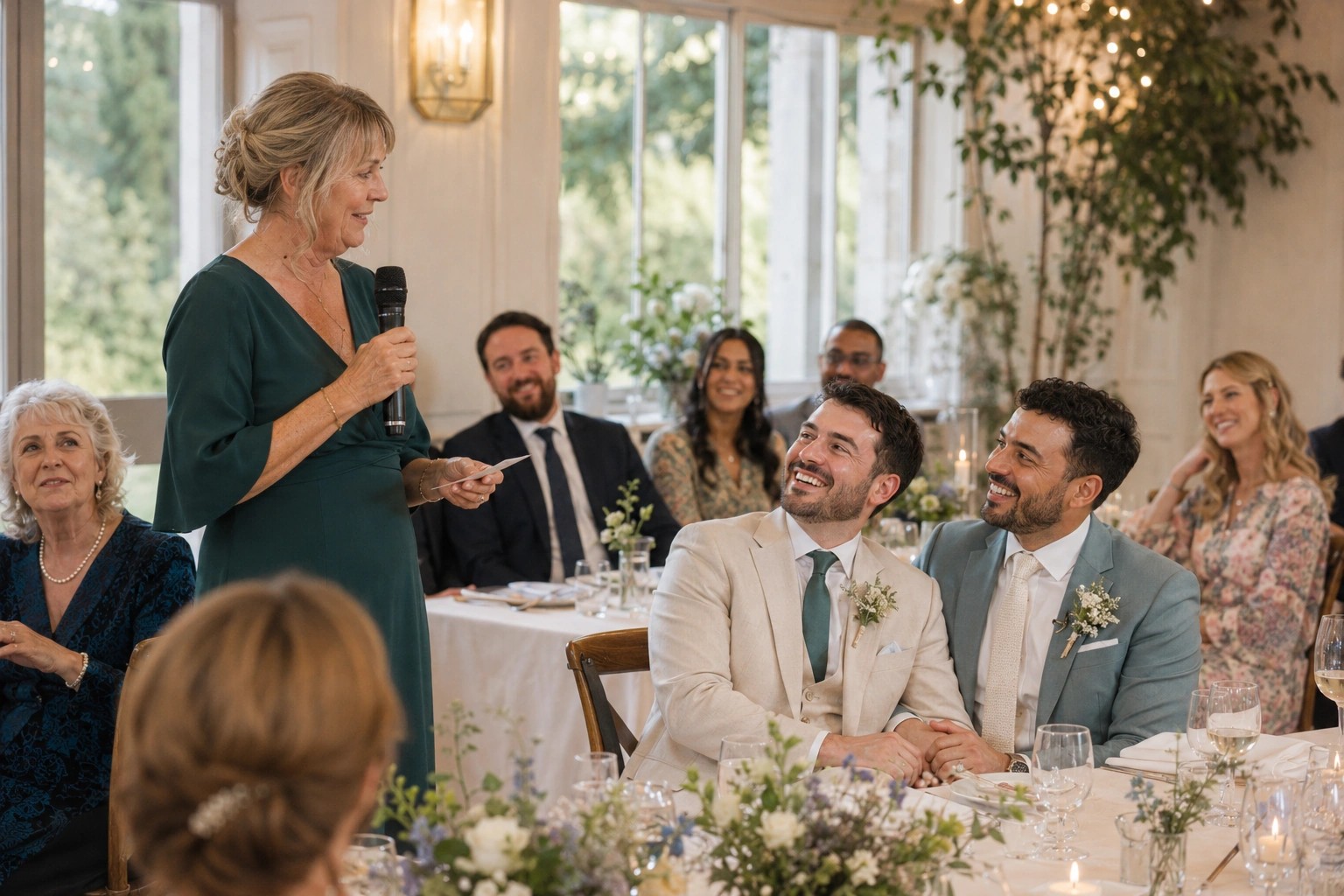
Unlike the father of the bride, the mother of the bride has no traditional script. There is no expected opening, no conventional set of thanks, no line about giving anybody away.
That sounds like a disadvantage. It is the opposite. It means nobody in the room has a template in their head that your speech is being measured against, and you can say the thing you actually want to say.
Why there is no established script
The traditional three-speech order — father of the bride, groom, best man — dates from a time when the bride’s father hosted the wedding and spoke on the family’s behalf. Traditional wedding convention simply did not assign the mother of the bride a formal speaking role.
Which means the convention has nothing to say about what you should cover. Modern weddings have quietly filled the gap in every possible way: mothers speaking instead of fathers, alongside them, jointly with them, or in place of the traditional line-up altogether.
You are not deviating from a rule. There isn’t one.
If the father is also speaking
The main practical question is division, and it is worth settling early — ideally before either of you writes anything.
Two speeches that both open by welcoming the guests, both tell a childhood story, and both welcome her partner will feel repetitive however good each one is individually.
A division that works:
- One of you handles the welcome and thanks — guests, travel, anyone who helped.
- The other opens straight into the personal material, which is a much better speech to give.
- Both may speak about her partner, but agree what each of you will say. One might describe how the relationship looked from outside; the other what they have come to value in them.
- One of you takes the toast, and the other closes on a line rather than a raised glass.
Trading childhood memories is where duplication usually creeps in, so pick different eras or different qualities. If he is doing "she was always determined", you take something else entirely.
If you are the only parent speaking
If you are speaking alone — through circumstance, choice or family structure — you have the whole territory, and the temptation is to cover all of it.
Resist. A mother of the bride speech does not need to be longer because it is the only parental one. Around five minutes is a useful target, although a focused three-minute speech can work perfectly well. Three to five minutes is still right. What changes is that you should probably include a brief welcome and thanks, since nobody else will have.
What only you can bring
This is the useful question, and it is more specific than “memories”. Think about the things you have witnessed that most other people in the room have not — the small, ordinary details that come from your particular relationship with your daughter.
Think about the things you witnessed that nobody else in the room did. Not the milestones — everyone has those — but the ordinary evidence:
- What she was like when she thought nobody was watching.
- The thing she worried about that she has long since stopped worrying about.
- What she was like as a small child that is still visibly true.
- The moment you realised she had become an adult, which is rarely the obvious one.
One of those, told properly, beats a chronological tour of school, university and first job.
Welcoming her partner
"Welcome to the family" suits some families perfectly well. For others it lands oddly, implying a probationary period that has finally ended.
The alternative is evidence rather than ceremony. Say what you have noticed: how they are with her, something they did that you did not expect, the moment you stopped thinking of them as her boyfriend or girlfriend and started thinking of them as family.
You do not need to claim you knew immediately. Almost nobody does, and honest warmth is more convincing than retrospective certainty.
Blended families, step-parents and absent parents
Where the family is complicated, the room does not need it explained.
Acknowledge people according to the relationships that actually exist rather than their titles. If there is a step-father who has been a father, say so plainly. If a parent is absent through estrangement, you are under no obligation to mention it at all.
If someone has died and you want to acknowledge them, agree the wording with your daughter beforehand. One sentence is usually enough — name them, say what the day would have meant to them, and return to the couple. Avoid springing an unexpected emotional tribute on the bride during her wedding.
Where several parental figures might speak, decide who is covering what. Four separate welcomes is a long afternoon.
Length and the toast
Around five minutes is a useful target. If both parents are speaking, keep the combined running time in mind and avoid covering the same ground twice. Two focused speeches will work far better than two long versions of the same material.
For the toast, use both their names clearly and make one wish. Then stop, rather than adding a final thought once the glasses are already up.
If you want help shaping it
The absence of a script is freeing, but a blank page is a blank page.
Our parent wedding speech writer asks about the memories, what you have noticed about her partner and what you most want her to hear, then shapes your answers into something written to be spoken. It covers mothers, fathers, step-parents and anyone speaking in a parental role.
You see the plan free before deciding anything. If the father of the bride is also speaking, our father of the bride speech guide may help you divide the material between you.