
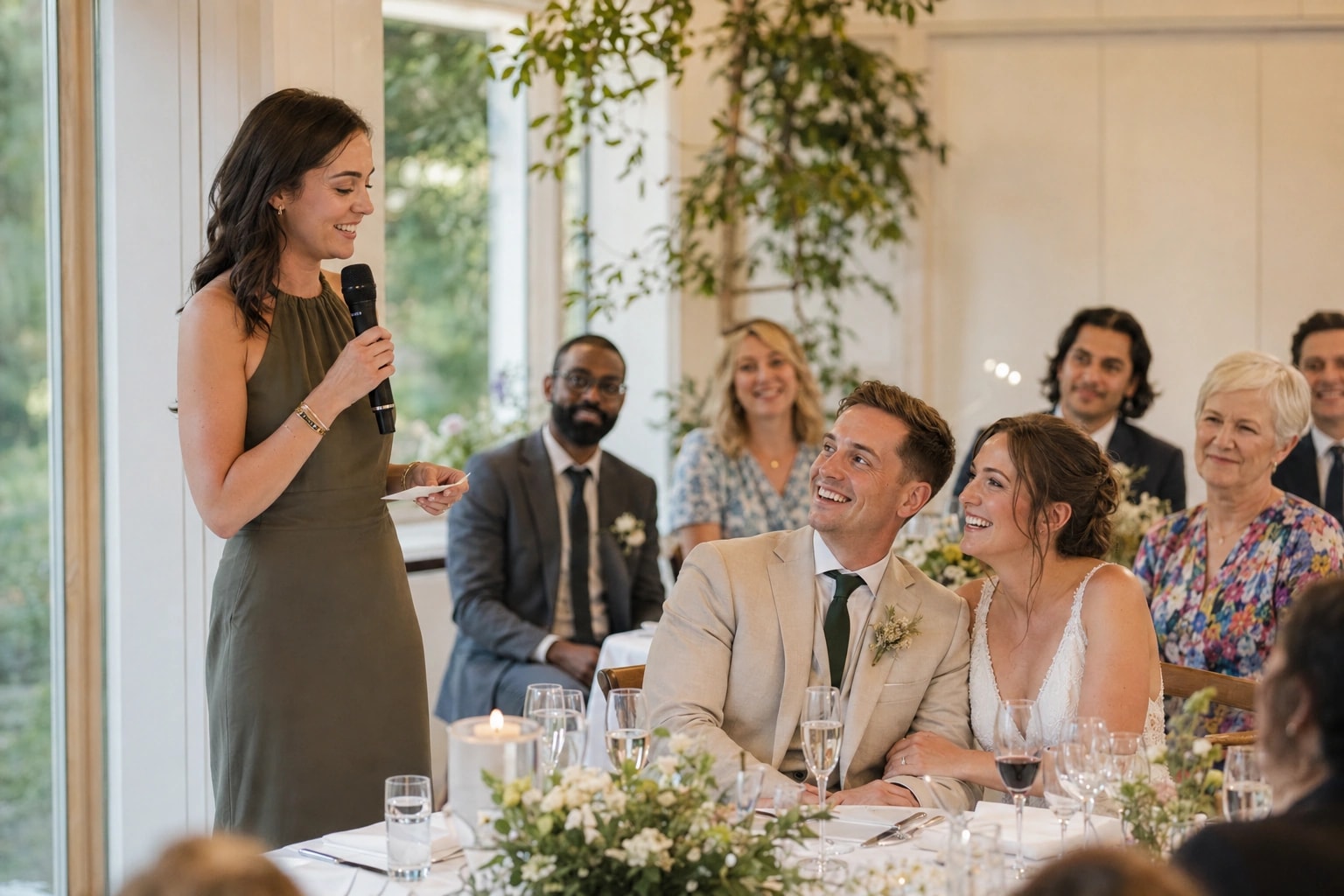
Four to six minutes is a useful target for a maid or man of honour speech — long enough for a good story, some warmth and a proper toast without asking too much of the room.
That difference is not a rule, and nobody will be timing you. But it reflects something real about how the speech usually sits in the day, and it is worth understanding before you decide your own length.
Why it tends to run shorter
There is no traditional fixed length for a maid or man of honour speech, and modern wedding running orders vary enormously. What matters more is the job the speech is doing.
This speech usually comes from a particularly close relationship with one member of the couple. One well-told memory, what that relationship has meant to you, a genuine welcome to their partner and a clear toast can comfortably fill four or five minutes without needing a catalogue of stories.
None of which means you must be brief. If you are the only person speaking, or you have been asked to cover more, take the room you need.
Where the time actually goes
Four minutes sounds like very little until you break it down:
- Introducing yourself and the friendship — 30 to 45 seconds
- One story, properly told — 60 to 90 seconds
- What that story says about her — 20 seconds
- Her partner — 30 to 45 seconds
- The direct, sincere part — 30 seconds
- The toast — 15 seconds
That is roughly three and a half minutes and it is already a complete speech. The room for a second story is genuinely tight, which is why one told well beats two told quickly.
The pause nobody budgets for
Here is the thing that catches maid and man of honour speakers more than any other role: you may need to stop for a moment.
This can be an emotional speech to deliver, particularly if you are a sibling or lifelong friend. Voices go. That is completely normal, guests find it rather touching, and there is no need to apologise for it — but it takes time that is nowhere in your word count.
Build in the assumption that you will need a breath somewhere. If your speech is exactly five minutes when read fluently at home, it may be six on the day, and that is fine as long as you have not also written six minutes' worth.
Timing it honestly
Reading silently is much faster than delivering the speech aloud, so it is a poor way to estimate the running time. To get a number you can trust:
Read it aloud, standing, at speaking pace. Leave the pauses in — including the ones after a line you know will get a reaction. Time the whole thing including the toast. Then do it again, because your pace will usually change once the words become more familiar.
A rough guide: 130 words per minute, so four minutes is around 520 words. Treat that as a check rather than a target.
What to cut
If you are over, cut in this order.
Your own backstory. How you met is worth a sentence, not a paragraph. The room needs enough to understand why you are speaking, not a chronology.
The second story. If both make the same point about her, keep the better one.
Explanations of in-jokes. If a story needs ninety seconds of context before it makes sense to her aunt, it is the wrong story.
Anything about how nervous you are. One line, at most.
Do not cut the direct part — the moment you stop describing her to the room and speak to her. That is what people remember, and it is the reason this speech exists.
If there are two of you
Two maids of honour, two men of honour, or a pair sharing the role is increasingly common, and it changes the maths.
A joint speech should not be double the length. Aim for five to six minutes total, not eight — the audience experiences it as one speech, however many people are delivering it.
Divide it into whole sections rather than alternating lines. One of you might open and cover the friendship, the other take a later story, and both contribute to the part about the couple. Constant back-and-forth is exhausting to listen to and much harder to rehearse.
Do practise it together, out loud, with the handovers marked. Joint speeches can run longer than expected, because every change of speaker introduces a pause that is easy to overlook.
Getting it to the right length
Our maid or man of honour speech writer asks about the friendship, the memories and what you genuinely want to say, then builds a speech to a target length you choose — so you are not trying to cut two minutes out of something you have already grown attached to.
You see the plan free first. And the Rehearsal Studio will time your real delivery aloud, including the pauses, so you know the true length rather than the optimistic one.