
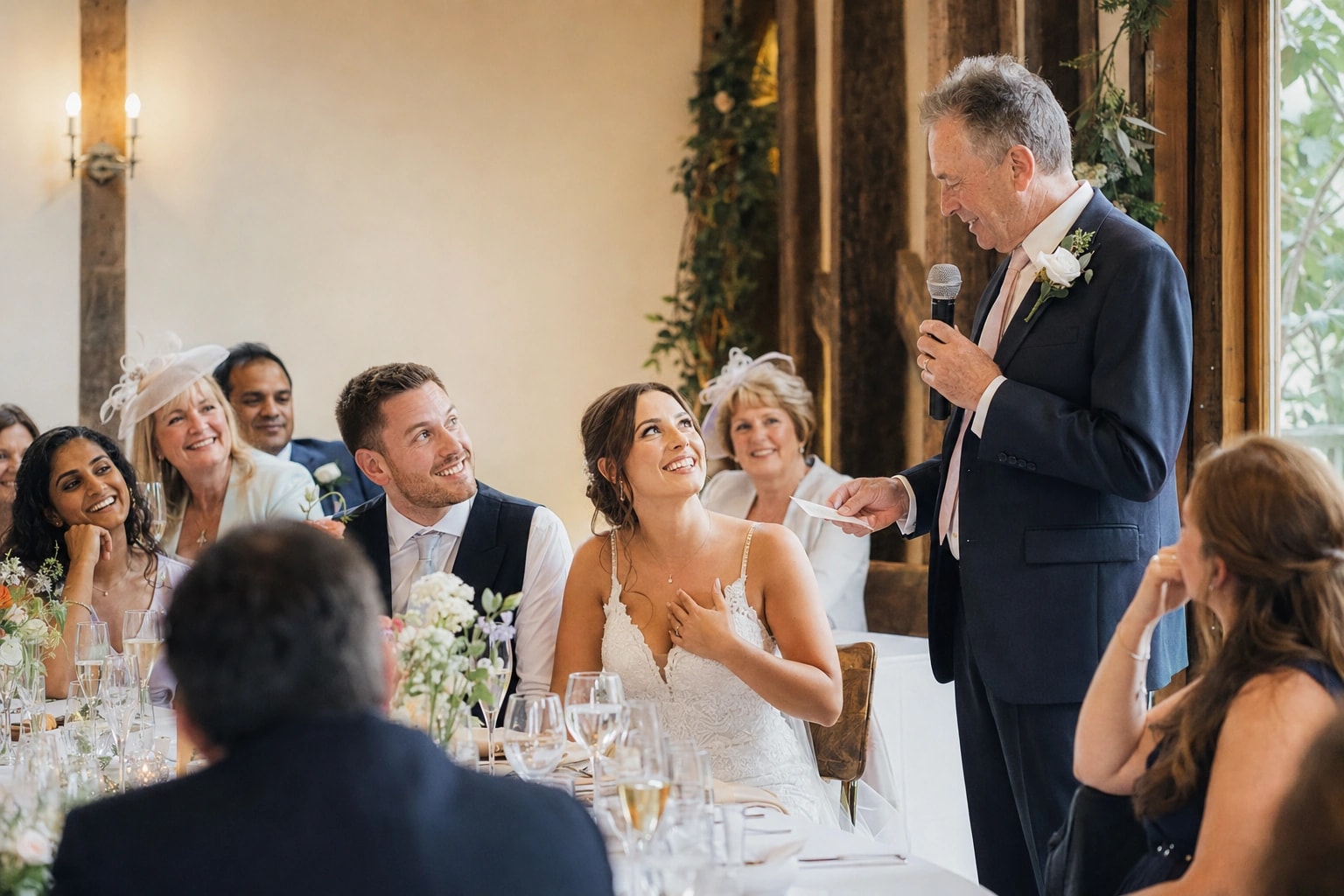
Most father of the bride speech examples you will find online have the same problem. They are polished, they are complete, and they are about somebody else's daughter. You read one, think that was nice, and are no closer to writing your own.
So the examples below come with their workings shown. Each one is followed by an explanation of what it is actually doing — which is the part you can genuinely use, because the structure travels even when the details do not.
All the names are invented. If you copy the words, the room will hear it.
Example one: the childhood story that goes somewhere
"When Hannah was eight, she announced that she no longer needed help assembling anything. This was shortly before the bookshelf collapsed, gently but comprehensively, across her bedroom floor.
She didn't cry. She didn't blame the instructions, and she certainly didn't ask for help. She sat down amongst the pieces, worked out what she'd got wrong, and started again.
That determination has followed her through everything since. The tools have improved, thankfully. The instinct hasn't changed at all — when something matters to Hannah, she gives it her whole attention, and she doesn't walk away when it gets difficult."
Why it works. The story is small. Nobody was hurt, nothing dramatic happened, and it takes twenty seconds to tell. What makes it land is the final paragraph, which converts a funny childhood memory into a statement about the adult sitting in front of everybody.
That conversion is the whole trick. A childhood anecdote on its own is just nostalgia — pleasant, forgettable. The same anecdote plus "and that is still who she is" becomes a portrait.
The shape to borrow: one specific incident, told with real detail, then one sentence explaining what it reveals about her now.
Example two: the opening that settles the room
"Good afternoon, everybody. For those who don't know me, I'm Michael — I'm Hannah's dad, and I've been practising this in the car for three weeks, which explains a great deal about my driving recently.
I want to thank you all for being here. Some of you have travelled a very long way, and one of you has come from Perth, which rather puts my forty-minute journey into perspective."
Why it works. It does three jobs in under thirty seconds: introduces him, gets a small laugh, and thanks people. It doesn't open with a joke about how nervous he is and then keep going back to it. One line, acknowledged, moved past.
The detail about Perth matters more than it looks. A specific guest, named by their circumstance, tells the room this speech was written for this wedding and not downloaded from the internet.
The shape to borrow: name yourself, one light line at your own expense, then thank people with at least one specific detail.
Example three: welcoming her partner without the old language
"I should say something about Daniel.
I'm not going to tell you I knew straight away. I didn't. What I noticed was smaller than that. I noticed that Hannah rang home more often. I noticed she'd started saying 'we' about things she used to decide alone. And I noticed, the first Christmas he came to us, that he was the one who quietly did the washing up while everybody else was arguing about the television.
Daniel, I'm not going to welcome you to the family, because you've been part of it for a while now and I suspect you noticed before I did."
Why it works. It refuses two clichés at once. It doesn't claim instant certainty, which nobody believes, and it sidesteps "welcome to the family" — a phrase that can imply somebody has been on probation.
Instead it uses evidence. Three specific observations, each small, which together say I have been paying attention to you far more convincingly than any compliment.
The shape to borrow: two or three things you have actually noticed, rather than a general statement about how pleased you are.
Example four: the sincere turn, and knowing when to stop
"Hannah, there are plenty of things I'm proud of. The degree, the job, the fact you finally learned to park. But the one that matters most is this: people feel better around you. You notice who's gone quiet. You spot the person on the edge of the group and go and stand with them.
Watching Daniel see that in you — and give the same care straight back — has been one of the quiet joys of the last few years.
Ladies and gentlemen, would you please raise your glasses. To Hannah and Daniel."
Why it works. He stops talking about his daughter and starts talking to her. The language gets simpler at exactly the point most speeches get more elaborate — "people feel better around you" is a plain sentence, and that is why it carries.
Then he stops. No second story, no final joke, no return to the microphone. The toast is the destination, not an administrative item at the end.
The shape to borrow: one honest sentence said directly to her, a line connecting her to her partner, then the toast. Nothing after it.
What all four have in common
Read them together and the pattern is fairly plain.
They are specific. Bookshelves, Perth, washing up at Christmas. Not one of them says "kind, beautiful and clever", which is true of every bride at every wedding and therefore tells the room nothing.
They are short. Each example is thirty to sixty seconds spoken. A five-minute speech is roughly six of these joined together, which is a much less frightening way to think about it than "five minutes".
They earn the sincerity. The emotional lines land because humour came first. A speech that is heartfelt from the opening sentence gives the room nowhere to go.
They resist the traditional phrasing where it has stopped meaning anything. No giving away, no losing a daughter, no gaining a son. Those phrases are available if they genuinely suit your family — but used automatically, they sound like somebody else's speech.
Using examples without copying them
The honest risk with any collection like this is that you borrow the words rather than the shape. Wedding guests have heard a great many speeches. Borrowed material has a particular flatness to it that people notice without being able to say why.
A better way to use these: read them once, then close the page and write down four things.
- A specific memory of her as a child, and what it says about her now.
- Something you have actually noticed about her partner.
- The thing you are proudest of that has nothing to do with achievements.
- One sentence you would want her to remember if you could only say one.
Those four answers, in that order, are already the skeleton of a good speech. The examples above are simply what it looks like when somebody else has filled the same skeleton in.
Getting help with yours
If you would rather not start from a blank page, SpeechAnvil asks you those questions properly — the memories, what changed when her partner arrived, what you admire, what must stay off-limits — and builds a speech from your answers in your own voice.
You see the plan and one fully written moment before paying anything. And once it is written, the Rehearsal Studio gives you a teleprompter, a timer and a recorder, so you can practise it out loud rather than reading it silently and hoping.
Because a father of the bride speech is rarely undone by the writing. It is undone by racing through it, or by saying it aloud for the first time with a hundred people watching.