
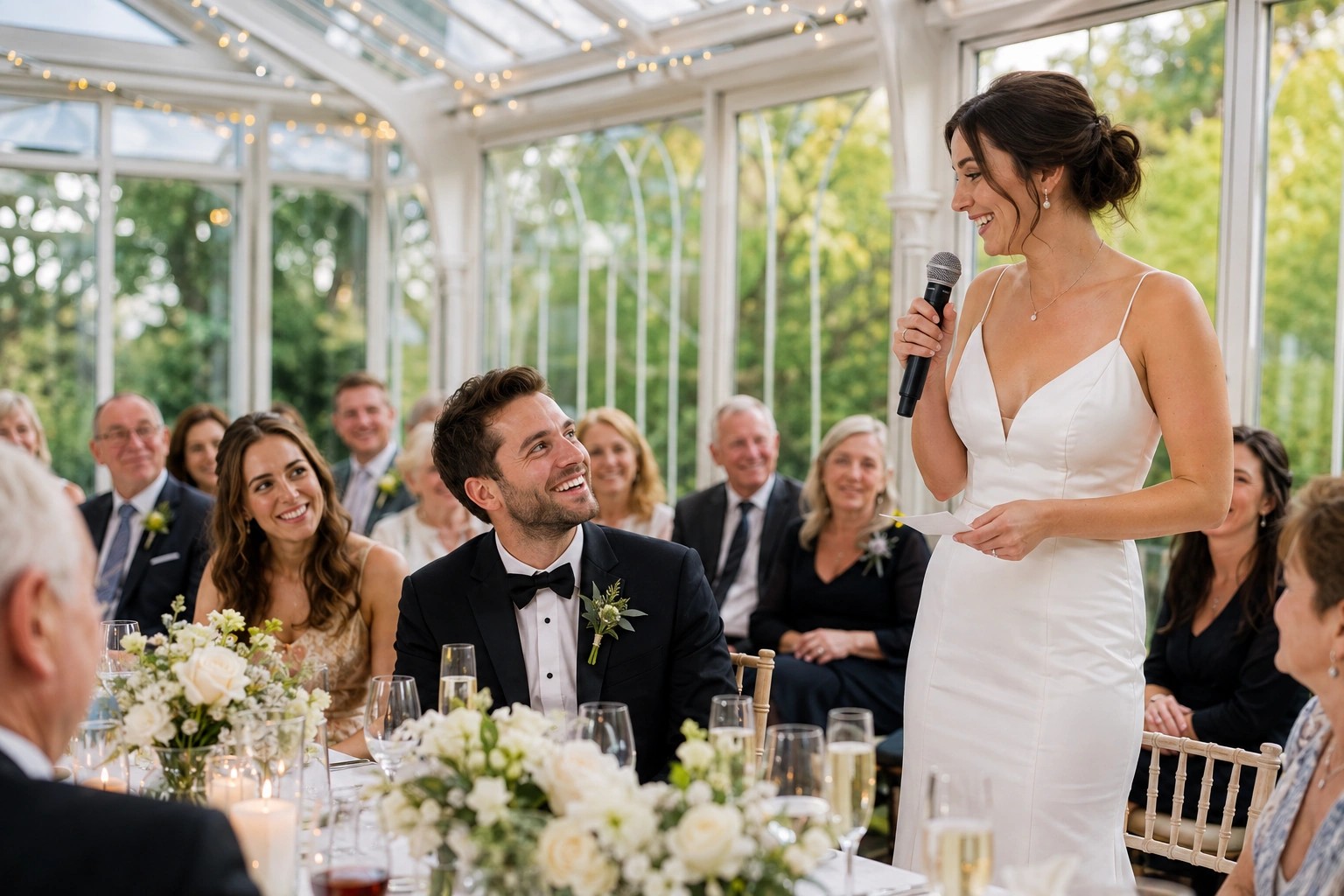
More brides are choosing to speak at their own weddings, and a common question is no longer whether it is allowed, but what a bride speech actually sounds like when there is no traditional model to copy. It is what one actually sounds like, given there is no traditional model to copy.
Here are four extracts, each followed by what it is doing and why. All the names and scenarios are fictional, and the point is the shape rather than the wording.
The opening: don’t apologise for being there
"Good evening. I’m Rachel, and in the interests of transparency I should tell you that at least four people have asked me this week whether the bride is allowed to give a speech.
I’ve decided she is.
Thank you all for being here. It is genuinely strange and lovely to look at a room containing my school friends, my colleagues, my aunt Marion and a man James works with called Big Kev, all in one place at the same time."
What it is doing. It acknowledges the mild novelty once, turns it into a joke at nobody’s expense, and moves on. That is the correct amount of attention to give it.
What it avoids is the version many brides write: a first minute spent explaining that traditionally the bride doesn’t speak, but times have changed, and so on. That frames your own speech as an exception. Better to simply give it.
Note "a man James works with called Big Kev". One specific guest, named, and the room knows this was written for this wedding.
The shape to borrow: one light acknowledgement at most, then straight into the thanks with a detail only your wedding contains.
Thanking people without reading a register
"Both our mums have spent the last year answering questions no reasonable person should have to answer. My mum can now identify seventeen shades of white by name. James’s mum drove across three counties to collect a cake stand.
And to everyone who’s travelled — particularly Priya, who has come from Auckland and has been awake since a day that hasn’t happened yet — thank you. It means more than we can properly say."
What it is doing. It thanks four groups of people in about twenty-five seconds, and every one of them gets a specific detail rather than just a name.
That is the whole trick with wedding thanks. "Thank you to my mum, thank you to James’s mum, thank you to everyone who travelled" is a list. Seventeen shades of white is a person.
The shape to borrow: group your thanks, and attach one concrete detail to each group rather than an adjective.
The relationship story, told from inside it
"People keep asking when I knew. The honest answer is that it wasn’t a moment, it was a Tuesday.
We’d been together about four months, and my car failed its MOT in a way that was going to cost more than the car was worth. I was sitting on the kitchen floor being fairly dramatic about it. James didn’t offer to lend me money, or tell me it would be fine, or explain what a catalytic converter is.
He sat down on the floor as well. And after about ten minutes he said, 'Right — shall we look at cars neither of us can afford, purely for entertainment?'
We spent two hours doing that. Nothing was solved. I felt enormously better. That’s still, I think, the most accurate description of what he’s like."
What it is doing. This is one of the advantages a bride has over speakers outside the couple: she can tell the relationship from inside it.
The story is deliberately unimpressive — no proposal, no holiday, no grand gesture. A kitchen floor and a broken car. That is exactly why it works; it could only be told by one of the two people who were there.
The shape to borrow: an ordinary moment that nobody else witnessed, told with the actual dialogue if you can remember it, ending on what it revealed.
Speaking to your spouse
"James, you are the least impressed person I have ever met, and I mean that as the compliment it is. You are not impressed by job titles, or by people being loud, or by me when I’m being unreasonable, which is genuinely useful.
You are impressed by very small things. Somebody being kind when they didn’t have to be. A good sandwich. My terrible impression of your dad.
I have spent four years watching you pay attention to the parts of life everybody else walks past, and I would like to spend the rest of it doing the same.
Would everybody please raise a glass — to my husband."
What it is doing. It turns to him, and the language gets simpler rather than grander, which is the opposite of what most people’s instincts suggest.
"You are impressed by very small things" is a plain sentence. It carries because of the three examples that follow, one of which is a joke, which stops the whole thing tipping into solemnity.
The toast is one line. No summary, no second thought.
The shape to borrow: one honest observation, two or three specific illustrations, one forward-looking sentence, then the glasses.
What these four share
None of them is a thank-you speech with a romantic bit at the end. The relationship is the centre, and the thanks are handled briskly on the way through.
They are specific to the point of being untransferable. Big Kev, seventeen shades of white, a kitchen floor, a terrible impression of somebody’s dad.
They are funny in places and serious in others. A little humour early can relax the room and create contrast when the speech becomes more sincere later, but there is no requirement for every bride speech to follow that pattern.
They are short. All four extracts together, plus linking sentences, is about four minutes.
Writing your own
Read these, then close the page and answer four things:
- What is the most specific detail about your guests that would make them laugh?
- Which two or three groups genuinely need thanking, and what did each actually do?
- What ordinary moment tells you most about your relationship?
- What is one plain, true sentence about your spouse?
That is the skeleton. The extracts above are just what it looks like when somebody else filled it in.
If you’d rather not start from nothing
Our bride speech writer asks about your relationship, the people you want to thank and what you most want to say to your spouse, then shapes it into a speech written to be spoken — in your voice.
You see the plan and one fully written moment free, before deciding anything. If your spouse is also speaking, our groom speech guide covers dividing the thanks between you so the two speeches don’t overlap.